|

|
| Founded By: | Robert White |
| Location: | Taunton, Somerset, England |
| Year Started: | 1983 |
| Year Wound Up: | 1987 |
| Titles in Database: | 20 |
| Rights Now With: | Robert White |
| | |
| | |
| | |
| Durell Software is a UK software developer based in Taunton, Somerset in the United Kingdom. The company is a provider of back office administration and accounting software to Independent Financial Advisers, Mortgage and General Insurance Brokers. Durell was formerly a leading video games developer.
Toward the end of 1987 Durell Software sold the rights to publish most of their existing games to Elite Systems and changed focus to developing financial services software solutions for the IFA, insurance and mortgage broking industries. Currently over 1,000 advisers and brokers use Durell's software.
In 2005 Mike Richardson, author of Durell's best selling titles for the ZX Spectrum, founded Durell Games Ltd. The first game to be developed by the company is Harrier Attack II, a sequel to their best-selling 8-bit game, which did not repeat its predecessors'success. After it, the company focused on insurance software |
Titles per Year

Breakdown by Genre
Breakdown by Platform
|
Added: 22 Mar 2017
Durell Software was founded in the early 1980s by Robert James Durell White. Originally trained as a teacher, then as a quantity surveyor, Robert decided to write programs of his own in February 1983. His first projects were for the Oric computer and included an assembler/disassembler and Moonlander and Asteroids games, all written in BASIC. The games were heavily commented and designed to be educational, teaching how to program a game in BASIC.
Advertising his cassette tapes in magazines, Robert sold his own creation by mail order. Realising it would be much more cost effective to do this if he had more products to offer, he advertised for programmers in the local paper. He soon recruited a small group of enthusiasts, including Ron Jeffs, Mike Richardson and later Clive Townsend and Nick Wilson. The group went on to write many classic titles during the eighties for Oric, Spectrum, Amstrad, BBC, Commodore 64, Atari ST and PC computers including Harrier Attack!, Starfighter, Chain Reaction, Critical Mass, Turbo Esprit, Thanatos, Saboteur and Saboteur 2, Sigma 7 and Operation Hormuz.
In 1987, due to the volatile nature of the games market, Robert decided to sell Durell's catalogue to Elite Systems, at which point Durell's name disappeared from the games industry. Durell Software Ltd, however, is still a going concern and develops administration and accounts packages for the insurance industry under the name of Durell Solutions.
20 years on, Mike Richardson, creator of Harrier Attack!, has brought the Durell name back to the games arena. Having founded Durell Gaming Ltd., the company's debut release is Harrier Attack II,a downloadable title for PC. |
Added: 12 Nov 2011
Why Durell? One of Robert White's middle names:
Robert James Durell White. | Crash! Issue 25
Added: 12 Nov 2011
(cont'd)
ed the screen to flip rather than scroll.”
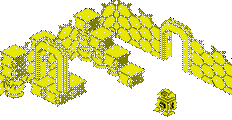
Basically, Saboteur rose from the ashes of Death Pit which was cannibalised for the routines it contained. Thanks go to a couple of Clive’s mates: Rich, and Mat the Fat. They playtested the game all the way through while it was being written, and Clive did promise he’d give them a credit. So now he has. No-one at Durell bothers too much with storyboards. Game ideas are bounced around the office, with everyone chipping in ideas and suggestions until the basic idea becomes a fairly detailed plan. Then it’s a matter of convincing Robert, the Big Cheese, that the idea is worth turning into a game. Stephen Parker, Durell’s marketing consultant also plays a part: “Steve advises me what he feels the market wants. Generally, as a result of Steve’s work, I think the more High-Tech scenarios involving vehicles and futuristic equipment are what people want,” Robert mentioned. Conversions are done in house. Nick Wilson was responsible for the BBC version of Combat Lynx and Mineshaft and is currently embroiled in the Amstrad version of Turbo Esprit. Ron Jeffs, who joined the company in its early days with Mike Richardson, began with the Oric, writing Harrier Attack and Scuba Dive and is currently converting Critical Mass for the Commodore. And Dave Cummings shouldn’t be left out of the namecheck — he’s the guy who replaced Clive on the graphics front. Watch out for him — he’ll be writing games soon, no doubt...
But games isn’t what Durell is all about. There’s a thriving Business Software section, where Phil Dierks and Mike Evis are currently working on an accounting package. Every now and again the games programmers lend a hand — writing the odd routine or whatever, more by way of taking a break. Robert White feels that the business software market represents an area of stability to back up the volatile games market. A game tends to have quite a short life nowadays whereas good business software can sell and sell (and sell). There’s little danger of the more ‘serious’ programs taking over, however. There’s very much a team atmosphere on the Castle Green in Taunton. When it comes to writing tricky routines, playing with the video camera or trying to blow up beachballs (literally — the ruins of one freebie plastic beachball over inflated by a robust pair of programmer’s lungs lay in a tattered mess on one desk), everyone joins in a together, offering advice and help. A fun place to work, obviously, And the overall company philosophy is a good one. “Every game we do should really be an improvement for each programmer,” Robert said, when pressed to come up with a snappy one-line description of the way of working at Durell. It’s plain the company is keen to train its programmers, and to develop their skills. That approach to software development (and programmer development) obviously works. | Crash! Issue 25
Added: 12 Nov 2011
(cont'd)
usive Smash this year...
Simon Francis, the author of Critical Mass is one of the more recent Durell finds. He first got interested in computers while he was at Middle school, when he messed around with a 7X81 owned by one of the Lab Technicians. At High School he learnt BASIC on a Pet and managed to persuade his father to buy him a Dragon 32. Simon’s interest in programming led him to write his own game. Being a bit short of cash (his pocket money couldn’t stretch to a programming book or an Assembler), Simon examined a machine code magazine listing, typed it in and fiddled around with the routines and got a basic understanding of how the code worked. Not the easiest way to learn Machine Code!
Using a scrolling routine he developed, Simon then wrote a Frogger type game on his Dragon, mainly in BASIC. He decided to see if he could make a few bob and placed a couple of classified ads in the back of computer magazines, offering his game for sale. While the loot didn’t exactly flood in, he made enough profit to be able to buy a book on machine code.
After a bit of studying Simon borrowed an Assembler and wrote Pit Fiend — which was marketed by Microdeal on their pocket money label. “The only clever thing about Pit Fiend in my opinion was the fact that I managed to get four voices on the Dragon,” Simon said. “Otherwise it was a run-of-the-mill game really. Still it got me started as a commercial programmer, and I decided to approach Audiogenic in the hope of getting a job, perhaps doing conversions.
“I’d shown Robert Pit Fiend, but he wasn’t interested in Dragon software. Then Robert offered me freelance work — I was at college doing A Levels at the time. I was given an Amstrad to play with, and came up with a Galaxians variant once I’d got the rudiments of Z80 code.” A couple of games on the Amstrad followed, and were marketed by Amsoft. Then, at the start of 1985 Simon was tempted away from college by a full-time job with Durell and work began on Critical Mass.
“I’m not entirely satisfied with Critical Mass”, Simon explained, “not with the actual program code, it’s just that the background’s a bit empty — the scrolling meant I couldn’t have as many fast-moving graphics as I would have liked.” Not bad for a first Spectrum game, though...
Currently, Simon is not sure what his next game is going to be. “I’ve got three ideas at the moment, which I’m thinking about. Soon I’ll have to persuade Robert that one of them warrants a game and then get on and program it,” he said. And no, we’re not going to print those three ideas here. Be a bit daft, wouldn’t it?
Mr Saboteur, Clive Townsend has been a dedicated follower of Sinclair since ZX81 days, when he wrote a Tarot Card program on the little beast. As soon as the Spectrum came out, Clive put his name down for one and quickly got to grips with the BASIC side of programming. “I wrote a couple of games — one ran rather slowly because it was all in BASIC and the other was much quicker, because I used a compiler... I took them both to Robert, and he liked the slow one because of the graphics and the fast one on account of its speed.”
The summer holidays followed, and Clive hung around the Durell offices learning machine code, making tea and wearing his cool-dude sunglasses. In May this year Durell decided to take him on fulltime, and he was set the task of writing a game called Death Pit on the Spectrum — mainly so he could learn how to apply the machine code he’d learnt. Death Pit has never been released — although halfway through the project there was a moment when it looked like the game might make a commercial release, it didn’t come up to scratch.
Saboteur came together slowly, and almost by accident. “I was doing graphics for other people on the Spectrum between sessions in Death Pit and I was playing around at home with some graphics of my own. I’m interested in Karate, and designed a Ninja who just ran around in a building on a scrolling screen. I showed what I had done to Robert in the office one day, and he liked the idea — only he want | Crash! Issue 25
Added: 12 Nov 2011
(cont'd)
a utility and then use it to write Harrier Attack.
Robert realised that he really needed four or five versions of the game — the home computer market in 1983 had not settled down as much as it has today. He advertised locally for programmers and Mike Richardson and Ron Jeffs joined the fledgeling company. With Harrier Attack (which attracted a bit of flak for its scenario — it was the time of the Falklands War), Durell moved to the present premises: a long attic room in an old building facing onto Taunton’s Castle Square. Mike Richardson had half completed a game on his Spectrum when he answered Robert’s advertisement. Having left school early, with nary a paper qualification to his name, Mike studied chemistry at night school and on day release schemes, collecting an HNC in computer studies on the way to his MSc in Chemistry. Working as a chemist in an aerosol factory, Mike bought himself a Spectrum and played around with it in his spare time. Robert hired Mike as a freelance programmer as soon as he saw the half finished game. And insisted Mike should complete it. Released at £5.50, Mike’s first game, Jungle Trouble, secured the Game of the Month slot in the Living Guide contained in Issue One of CRASH. Mike also wrote Harrier Attack. Taking a break from his Spectrum, Mike wrote Harrier Attack for the Amstrad — a couple of weeks work. Then it was back to the Spectrum for six months, writing Scuba Dive, a game with an underwater scenario which puts you in control of a diver, searching for pearls on the sea bed. At the time Scuba Dive won particular acclaim for its graphics. In those days, the CRASH Smash hadn’t been invented — otherwise Scuba Dive’s 92% overall rating would have made it one of the first Smashes.
Combat Lynx was Mike’s next project, which was released on the Spectrum in the Autumn of 1983. The CRASH Smash HAD been invented, but sadly, Mike missed the mark by a couple of percentage points. It still ranks high amongst Cockpit games, even after twelve months and the advent of several more high-quality flying games. Eight months work this time... “Each successive program is taking longer to write,” Mike admits ruefully, “I suppose it’s getting more difficult to keep up with advances in the quality of games.”
Writing on a CP/M machine running the Microsoft Assembler/Editor and downloading code to the Spectrum through a parallel interface, Mike is currently working on a driving game with a difference — Turbo Esprit. In the game you take the wheel of a Lotus Turbo Esprit, driving through a scrolling cityscape in pursuit of drug runners. You take on the role of a Special Agent and you’re up against a gang of criminals who have stashed their heroin at a number of safe houses. Now, members of the gang are ferrying consignments of drugs to an armoured van which is driving through the streets. If you were to raid one of the houses the alarm would go up and you’d miss the rest of the haul. Similarly, if you attacked the armoured van, the gang would scarper with the remaining heroin. The only course of action open to you is to find the cars and intercept them on the way to the drop.
Zooming through the streets (some of which are one-way) you have to find the gangster cars, circle round the block and shoot them up. All the time there are other road users and pedestrians to cope with, traffic lights, junctions and the odd petrol station to call in on and refuel the car. You can view the action through the windscreen of your Esprit or flip to an aerial map of the city streets to plan your route. You’ll have to be careful, though. Turbo Esprits are expensive and your bosses have only given you three to play with — crash ’em all, and you’re out of the game.
Looking at an early version of the game in Durell’s offices in the first week of December it was clear why Mike is taking longer to write it. The level of detail in the landscape and the way in which the traffic and pedestrians all go about their business should make the finished product quite a stunner. Maybe Mike Richardson will get that el | Crash! Issue 25
Added: 12 Nov 2011
FROM FINDING KITCHEN UNITS ON THE CEILING TO WRITING CRASH SMASHES
A Software Success Story from Taunton, Somerset
DURELL Software Limited began life in February 1983, when Robert White plonked a 48K Oric and an Epson printer on a desk in Taunton and began writing home computer software. While the Oric has not proved to be a runaway success story, Durell hasn’t done too badly over the past years. Nearly a quarter of a million copies of one of their earlier games, HARRIER ATTACK, are nestling in software collections around the world, for instance. (Not all Spectrum versions, mind.)
When their last two games for the Spectrum, CRITICAL MASS and SABOTEUR were both awarded CRASH Smashes, it was time to nip down to Taunton and find out who these Durell fellows are...
Maybe it has something to do with the zoologist, but for some reason, people (including us!) find it a little difficult to spell Durell’s name correctly. More than once it has appeared as ‘Durrel’ or ‘Durrell’. Durrel it is, pronounced dew-rel. Now that the nomenclature is sorted out, it’s time to turn attention to the people behind the name.
While he was training to be an Art Teacher, Robert White has no idea that he was going to end up as a software house boss. Once he’d completed his Art training, however, he soon realised that he was unlikely to go very far as an Art Teacher — there wasn’t that much demand. Robert then decided that a career in Quantity Surveying might put an end to his joblessness. So he went back to college, and after a couple of years hard slog, left with a first class degree in Quantity Surveying. During the course, he was introduced to computers, used for modelling. When he finished his studies Robert rather cheekily applied for a job with Oxford Regional Health Authority. They were using a computer-based building design system to create a model of Milton Keynes District General Hospital and Robert’s mixture of skills in art, computer modelling and quantity surveying secured him the job.
Durell team
The Durell team gathered together, photographing us photographing them. Little did they know, someone else was photographing all of us...
“The model of the hospital was a fully accurate three dimensional representation of the building, right down to the very last doorknob and window catch,” Robert explained. “The whole hospital was being designed on computer — as you can imagine, it was a massive undertaking.” The first task allocated to the ‘new boy’ on the team was to find some kitchen workunits in the model! For some reason, when the list of kitchen units needed for the real building was output from the computer, there turned out to be exactly twice as many as the architect KNEW were needed. Robert had to hunt through all the kitchens, looking for the extra units: “It took me quite a while to make the conceptual jump needed to find them,” he remembers, “in the end, they turned out to be on the ceilings! Evidently another architect had entered the units into the model, but had been on the ceiling of the kitchens rather than the floors. Then someone else had come along later, noticed there weren’t any kitchen units on the floors of the appropriate rooms and entered them into the model again.” Quite a jump from kitchen units in Milton Keynes Hospital to home computer software, but jump Mr White did after a while. “I was bored,” he explained. “I really didn’t want to carry on being someone else’s employee and saw there was an opportunity to set up a business of my own producing computer software. So I made the break...”
Durell didn’t start off as a mega-buck company. “I began with an Oric and an Epson printer — and the printer was an investment I thought long and hard about”, Robed explained. Robert and his wife, Veronica, moved from Oxfordshire to a house near Taunton which his mother-in-law owned — so in the early days of Durell there wasn’t a mortgage to worry about. Veronica continued working as a drama teacher while Robert sat down to write an Assembler on his new Oric. Plan A was to finish the Assembler, market it as |
Added: 12 Nov 2011
Durell was founded in 1983 by Robert White. From 1983 to 1987, Durell developed 19 games for various 8-bit computers including the Oric-1, ZX Spectrum, Commodore 64, Acorn BBC Micro, Acorn Electron and the Amstrad CPC. Their biggest hit was Harrier Attack, developed by Mike Richardson, which sold over 250,000 copies. |
Hung Rasp
Added: 19 Apr 2019
What if you could automate all of your social media channels in a compliant way that allows you to get more leads and conversions while you focus on doing what you love?
It is now possible to automate Messenger, Facebook, Instagram, Linkedin, Pinterest, Reddit, YouTube, and Twitter with robotchatbot.com.
Robotchatbot.com is compliant social media automation that is approved under each social network’s strict API and review process.
If you are tired of responding individually to posts, moderating comments, or having to upload each post individually into its own campaign for each social media channel, then you really should check out robotchatbot.com.
Still not convinced? Then you can try it FREE for 14 days. Just the time saved from streamlining posting to your social media profiles is a game-changer not to mention all of the automation features packed into to robotchatbot.com.
You can also make Messenger bots that help customers and upload them to your website and so much more!
Try it for 14 days free at robotchatbot.com.
| Janina Do
Added: 17 Apr 2019
I was browsing through your site and was amazed at the amount of time it must have taken to create such an aesthetically pleasing design.
Did you know that it is possible to get a loan to take your website to the next level, regardless of your credit and current income? I recently took one out for scaling my FBA business through Bitbond.
I am not sure if you have ever heard of Bitbond or not, but it is a way for individuals to utilize Peer to Peer lending. I am sure you already know what P2P lending is, but if not, it’s a way to connect with people who have money to lend out at a fair interest rate. These are not institutions or banks, these are individuals just like you and I.
The best part is, your privacy is protected every step of the way, with no important information ever being released to investors.
BitBond has over 1,000+ TrustPilot reviews and a stellar reputation in the financing community. Like I said, I have used them myself.
If you are looking to take your business to the next level, you should really take the time to check them out.
They are actually running a special offer for new invited members, you can check it out at https://www.bitbond.com/?a=47F7M7ECZN.
Keep crushing it!
Jamie Conrad | The Retro Isle team
Added: 5 Jul 2026
Click here to view a list of titles we have in the database here at Retro Isle. |
Margareta Brier
Added: 17 Apr 2019
I just wanted to let you know, your website took a little bit to load (just over 6 seconds), it could be my connection contributing to the delay, but most likely it is your hosting server or lack of resources available.
You may want to take a look and see where you can optimize it to speed your website up.
I was dealing with something similar and it is even more frustrating when you do not know this is happening, so I wanted to reach out and let you know.
It could be anything from a simple mysql query hanging to improper usage of resources through 3rd party scripts. If you have linux and terminal access, you can type “top†and see your current resource usage/allocation.
I don’t envy your situation, hopefully your hosting team is ready to help you resolve this issue if you need them, mine wasn’t.
If your hosting was like mine, then you should look at joining Red Line Web Hosting, they are offering a special for the first 100 customers. I believe it is 90% off any hosting plan, but you will have to check for yourself to be sure. They also offer domains for under a $1.00 sometimes.
In order to see the new customer discounts, you have to have the landing page link for new customers. I bookmarked it when I first joined, so I could use the deals again and share them with friends.
If you want the new customer link it is https://www.redlinewebhosting.com/?lp=newcustomer.
Like I said, I hope it was just my connection, but you may want to take a look for yourself to be sure.
Take care and best of luck to you!
Margareta |
Added: 12 Nov 2011
In 1987, due to the volatile nature of the games market, Robert decided to sell Durell's catalogue to Elite Systems, at which point Durell's name disappeared from the games industry. Durell Software Ltd, however, is still a going concern and develops administration and accounts packages for the insurance industry under the name of Durell Solutions.
20 years on, Mike Richardson, creator of Harrier Attack!, has brought the Durell name back to the games arena. Having founded Durell Gaming Ltd., the company's debut release is Harrier Attack II,a downloadable title for PC. |
Added: 12 Nov 2011
Toward the end of 1987 Durell Software sold the rights to publish most of their existing games to Elite Systems and changed focus to developing financial services software solutions for the IFA, insurance and mortgage broking industries. Currently over 1,000 advisers and brokers use Durell's software.
In 2005 Mike Richardson, author of Durell's best selling titles for the ZX Spectrum, founded Durell Games Ltd. The first game to be developed by the company is Harrier Attack II, a sequel to their best-selling 8-bit game, which did not repeat its predecessors'success.[1] After it, the company focused on insurance software |
|