


Soul Blade (1996) 


| Details (Sony Playstation) | Supported platforms | Artwork and Media | |
|---|---|---|---|
| Publisher: Genre: Author(s): Maximum Players: Joysticks: Language: Media Code: Media Type: Country of Release: Comments: |  Namco NamcoFighting Namco SCPH-1010/1080 or Dual Shock SCPH-1200 controller Eng SCES-00577 DVD (Protected) USA, Europe, Japan | Sony Playstation |
| Videos | Screenshots (Sony Playstation) |
|---|---|
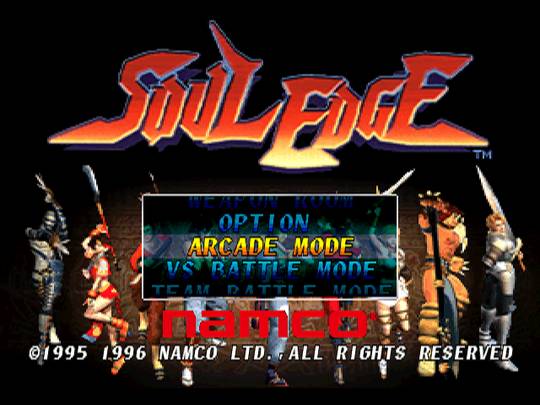 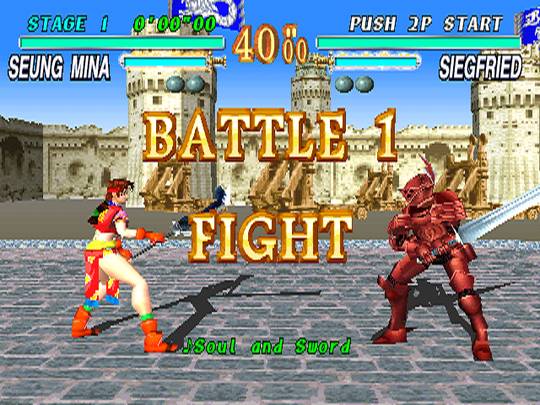 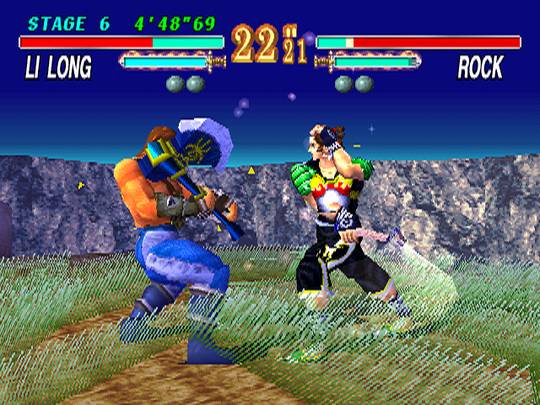   |
Please login to submit a screenshot
| Your Reviews |
|---|
 (Anonymous) (Playstation Review) 17th Apr 2012 10:16
"The TRUE evolution of fighting games."
It's amazing how the world of fighting games developed after the "boom" years (1991-1993). Street Fighter II gave us probably the most memorable and copied characters, stories, moves and terminology ever. Mortal Combat came and shocked and awed fans with its fatalities and "realistic" characters. Virtua Fighter came and showed that a fight could exist in 3D and could be decided by Ring-Outs. And, of course, there were innumerable clones of SF, MK, or any combination of the two (Time Killers, Violence Fight, World Heroes, Fatal Fury, Killer Instinct, etc.). In 1994 TEKKEN arrived, showcasing perhaps the best mixture of the fighting game formulas of the past, namely an engaging and memorable characters, realistic-looking characters and backgrounds, 3D movement, combos and juggles, and of course, an original fighting engine with a simple button layout. It seemed that fighting games had reached the peak of their evolution.
BUT, in 1995 Namco introduced WEAPONS into the world of fighting with the release of Soul Edge. While it looked and played similarly to Tekken, this game was truly original and a milestone. Memorable characters, great graphics, 3D movement, an easy learning curve made this game a classic. Soul Blade, the console version of Soul Edge, is STILL simply amazing. I will list the features I can remember and state the good and then the bad aspects of them.
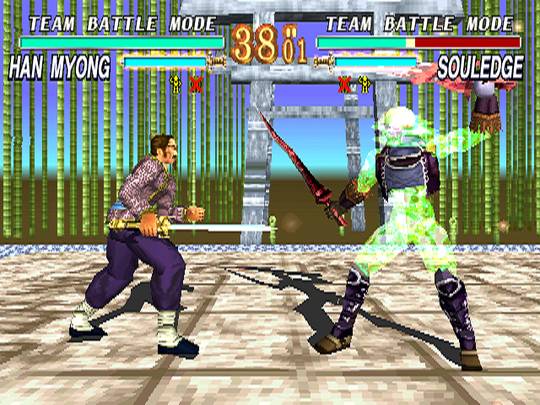
1. Characters - There are 10 standard characters at the beginning of the game and 5 hidden characters who are unlocked by various means. The characters are different and original. Their looks and movements are totally unique. The costumes are appropriate and colorful without being tacky. There are 5 costumes for each standard character. Of the 5 hidden characters, one is Soul Edge (called Inferno in later games) who is basically a stronger version of Cervantes; another is an enhancement of Siegfried (later called Nightmare). Two of the hidden characters are essentially hidden costumes of for Sophitia. The remaining hidden character is Han Myong, the father of Seung Mina and teacher of Hwang. The only negative thing about these characters is that there are so few of them. I don't count the 2 hidden Sophitias as characters, just costumes, so there are really only 13 usable characters in the game. By this time, other games had at least 16 characters. However, since this was the first game in the series, it's quite acceptable. After all, SFII had only 8 usable characters at its debut, MK only 7.
2. Story - The story is very similar to the Lord of the Rings myth, which is to say it's engaging, universally understood, and marketable. All the warriors seek the mythical swords Soul Edge for the purposes of saving lives, saving a country, gaining immortality, gaining revenge, restoring the past, for use as the ultimate weapon, or for simply out of mad addiction. Each character's story can be told THREE different ways, through the arcade ending, the secret arcade ending, and the Edge Master mode. The arcade endings beautifully and effectively illustrate what happens to each character as they finally grasp Soul Edge. The "book" in Edge Master mode uses text to fully explain what you've seen, as well as flesh out the character's history leading up to the fateful moment. Certain endings actually foreshadow a sequel. I believe this is the pinnacle of fighting-game storytelling. This game draws the player into the life and plight of each character like no other. What is accomplished, narratively speaking, in this one game takes other franchises three or four titles, a few animes, and maybe a bad movie adaptation to do.
3. Weapons - This is what sets it apart from other fighting games. I think this game has an excellent balance of familiar weapons (katana, nunchaku) and unusual weapons (katar, double swords). In this home version, multiple weapons of the same type can be unlocked for each character. These bonus weapons have special attributes and deficiencies. For example, your default weapon has no special properties. The first weapon you unlock might have a greater length and swing speed, but poor defensive capabilities. The second weapon you unlock might cause you to regain lost life, but is not very damaging to your opponent. Adding to the sense of realism is the fact that although you fight with a weapon, it may be taken away from you by a weapon gauge (which decreases due to excessive blocking), forcing you to fight barehanded! Since this game set the precedent, there is nothing to compare it to. But what a precedent! The subsequent SC titles have not even come close to recreating the distinction between special weapons or the need to develop true weapon-based strategy.
4. Modes - This game has Arcade, Vs Battle, Team Battle, Time Attack, Survival, Practice, Edge Master mode, and Options. While Arcade, Vs Battle, and Options are the essential fighting game modes, it is a treat to have Team Battle (up to 5 on 5), Time Attack (fastest time through Arcaden no endings), and Survival (fight until you have no more life) modes. The Practice mode is great because it allows you to access the move list to perfect your timing and combos It also lets you set up different situations, such as fighting a CPU opponent at the hardest level to see what strategies it uses. Nothing is better than picking your best character, picking whoever you think is the worst character as your opponent, setting the CPU to level 10, taking away their weapon, and then watch as they STILL destroy you barehanded! For the reasons mentioned above in number 2, Edge Master mode is the best mode in this game. I forgot to mention that the bonus weapons are unlocked only in Edge Master mode. Like so many things in the rest of the series, no mode of similar design or intent has been executed so thoroughly and consistently as in this game.
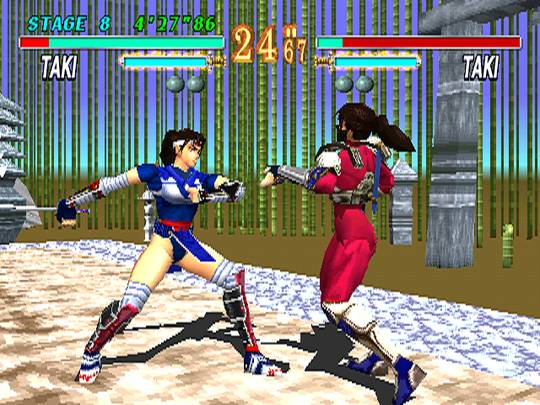
5. Stages - The stage concepts are original and appropriate to the era. Siegfried fights in the courtyard in a castle; Cervantes fights on a platform in a harbor, Voldo fights in a hastily constructed, underground storeroom, Rock fights on a huge stone monolith. Those are all fine examples of standards, since the stage should be appropriate for the character. What is truly fantastic about the stages is that they are seemingly alive! If you fight in the outdoor stages long enough, you can see the night turn into day and back. Even your shadows move! But it's not quick, it only happens around the end of the second round or beginning of the third. This makes it seem real. In Cervantes' or Li Long's stages, you fight on the water, and so your platform or raft rocks back and forth while "land" stays still. In Taki's stage the flying spirits occasionally fly into the foreground "at you." Sophitia fights on a huge, glass chess board that glows. Since it is glass, you can see through it. These are truly great stages. If there is any complaint it is that once you get to the horizon, there is just a sharp contrast which makes the stage have a little less depth.
6. Music - This is the second or third most important part of this game. From the intro sequence ("The Edge of Soul") you immediately get the impression that this game is going to be an entirely different fighting game. First off, the soundtrack is orchestral in nature, and that right there sets it apart from ALL other fighting games, which usually use techno-sounding music or music that sounds like pop radio trash. Secondly, given the greater expressive potential of an orchestra, the essence of each stage is truly captured to its fullest. Here are some examples. Rock is in the "new world" which will one day be America. This essence of open, American outdoors is captured excellently in the driving, syncopated rhythms, lots of brass and a series of sweeping violins. Siegfried's stage is a castle in Europe which has come under attack. Since Europe in the 1500s was almost entirely Christian, it makes sense that his music features a section of a vocal chant followed by a chorus of "Alleluias" to go along with the dramatic action music which is accented by snaredrum and timpani. The rest of the music from this game is just as sophisticated and thought-provoking. And here is the other bonus: there are TWO (2) other soundtracks contained in the game as well! There is an Arranged version which is the same as the Original but with slightly different instruments for the same music. The third soundtrack, the Khan Super Session, was created specifically for the console release. It follows the techno/dance-music-trend. While it takes a bit of getting used to, after growing accustomed to the orchestral masterpiece, it doesn't sound too bad.
7. Sound - The slices and hits are pretty standard. The voice acting is somewhat interesting because some attention was given to the languages. Voldo actually gasps and hisses, the Asian characters speak Japanese (I assume), and most of the Caucasian characters speak English. I suppose it might be too much to ask that Li-Long speak Mandarin or Cantonese. It might be an extreme request to have Cervantes de Leon speak like a Spaniard as opposed to an English pirate ("Aarrgh me mateys!"). And people might make funny faces if Siegfried actually said one word of Deutsch, his native tongue, but I really believe it would have put on the finishing touches on this excellent game.
8. Graphics - The graphics of this game are not bad considering this was 1996-1997; the console was a PSX and 3D movement was the norm only with Virtua Fighter and perhaps Tekken. As it stands there was definitely some choppiness (joining limbs) and some very poor textures (the "grass" in Rock's stage), but the graphics are in keeping with the era and are at least as good as Tekken 2 or 3.
9. Gameplay - Well, with so much praise heaped on this game I think it's only fair to point out its only flaw. It's a huge flaw. While the controls are easy enough to figure out and the moves can be found in the move list, the timing, responsiveness, and overall flow are horrendous. Playing the game I often say to myself "That wouldn't happen in Soul Calibur(1,2,3)!" This means that the seed for an excellent fighting game is here, it just hasn't fully developed. If you can play patiently, simply, diligently, and not rely on Guard Impacts, (almost like a 2D fighter) then you will be successful.
10. Presentation - This game is very well presented. The importance of the quest, the life-or-death struggle of the characters, the seemingly real accounts in the Edge Master "books," the secrets, the seriousness of the music, and especially the demo intro sequence all overshadow faulty gameplay and less-than-stellar graphics to make this fighting game an awesome experience to behold!
In summary, if you can find this game, get it! You will never regret it. The replay value is extremely high. Even to this day, when I hold the game, with it's perfect jewel case, unopened instruction booklet, and flawless disc, I can almost feel the energy radiating from it.
Like the power of the cursed swords, it calls to me...
Reviewer's Score: 9/10, Originally Posted: 01/27/06
It's amazing how the world of fighting games developed after the "boom" years (1991-1993). Street Fighter II gave us probably the most memorable and copied characters, stories, moves and terminology ever. Mortal Combat came and shocked and awed fans with its fatalities and "realistic" characters. Virtua Fighter came and showed that a fight could exist in 3D and could be decided by Ring-Outs. And, of course, there were innumerable clones of SF, MK, or any combination of the two (Time Killers, Violence Fight, World Heroes, Fatal Fury, Killer Instinct, etc.). In 1994 TEKKEN arrived, showcasing perhaps the best mixture of the fighting game formulas of the past, namely an engaging and memorable characters, realistic-looking characters and backgrounds, 3D movement, combos and juggles, and of course, an original fighting engine with a simple button layout. It seemed that fighting games had reached the peak of their evolution.
BUT, in 1995 Namco introduced WEAPONS into the world of fighting with the release of Soul Edge. While it looked and played similarly to Tekken, this game was truly original and a milestone. Memorable characters, great graphics, 3D movement, an easy learning curve made this game a classic. Soul Blade, the console version of Soul Edge, is STILL simply amazing. I will list the features I can remember and state the good and then the bad aspects of them.
1. Characters - There are 10 standard characters at the beginning of the game and 5 hidden characters who are unlocked by various means. The characters are different and original. Their looks and movements are totally unique. The costumes are appropriate and colorful without being tacky. There are 5 costumes for each standard character. Of the 5 hidden characters, one is Soul Edge (called Inferno in later games) who is basically a stronger version of Cervantes; another is an enhancement of Siegfried (later called Nightmare). Two of the hidden characters are essentially hidden costumes of for Sophitia. The remaining hidden character is Han Myong, the father of Seung Mina and teacher of Hwang. The only negative thing about these characters is that there are so few of them. I don't count the 2 hidden Sophitias as characters, just costumes, so there are really only 13 usable characters in the game. By this time, other games had at least 16 characters. However, since this was the first game in the series, it's quite acceptable. After all, SFII had only 8 usable characters at its debut, MK only 7.
2. Story - The story is very similar to the Lord of the Rings myth, which is to say it's engaging, universally understood, and marketable. All the warriors seek the mythical swords Soul Edge for the purposes of saving lives, saving a country, gaining immortality, gaining revenge, restoring the past, for use as the ultimate weapon, or for simply out of mad addiction. Each character's story can be told THREE different ways, through the arcade ending, the secret arcade ending, and the Edge Master mode. The arcade endings beautifully and effectively illustrate what happens to each character as they finally grasp Soul Edge. The "book" in Edge Master mode uses text to fully explain what you've seen, as well as flesh out the character's history leading up to the fateful moment. Certain endings actually foreshadow a sequel. I believe this is the pinnacle of fighting-game storytelling. This game draws the player into the life and plight of each character like no other. What is accomplished, narratively speaking, in this one game takes other franchises three or four titles, a few animes, and maybe a bad movie adaptation to do.
3. Weapons - This is what sets it apart from other fighting games. I think this game has an excellent balance of familiar weapons (katana, nunchaku) and unusual weapons (katar, double swords). In this home version, multiple weapons of the same type can be unlocked for each character. These bonus weapons have special attributes and deficiencies. For example, your default weapon has no special properties. The first weapon you unlock might have a greater length and swing speed, but poor defensive capabilities. The second weapon you unlock might cause you to regain lost life, but is not very damaging to your opponent. Adding to the sense of realism is the fact that although you fight with a weapon, it may be taken away from you by a weapon gauge (which decreases due to excessive blocking), forcing you to fight barehanded! Since this game set the precedent, there is nothing to compare it to. But what a precedent! The subsequent SC titles have not even come close to recreating the distinction between special weapons or the need to develop true weapon-based strategy.
4. Modes - This game has Arcade, Vs Battle, Team Battle, Time Attack, Survival, Practice, Edge Master mode, and Options. While Arcade, Vs Battle, and Options are the essential fighting game modes, it is a treat to have Team Battle (up to 5 on 5), Time Attack (fastest time through Arcaden no endings), and Survival (fight until you have no more life) modes. The Practice mode is great because it allows you to access the move list to perfect your timing and combos It also lets you set up different situations, such as fighting a CPU opponent at the hardest level to see what strategies it uses. Nothing is better than picking your best character, picking whoever you think is the worst character as your opponent, setting the CPU to level 10, taking away their weapon, and then watch as they STILL destroy you barehanded! For the reasons mentioned above in number 2, Edge Master mode is the best mode in this game. I forgot to mention that the bonus weapons are unlocked only in Edge Master mode. Like so many things in the rest of the series, no mode of similar design or intent has been executed so thoroughly and consistently as in this game.
5. Stages - The stage concepts are original and appropriate to the era. Siegfried fights in the courtyard in a castle; Cervantes fights on a platform in a harbor, Voldo fights in a hastily constructed, underground storeroom, Rock fights on a huge stone monolith. Those are all fine examples of standards, since the stage should be appropriate for the character. What is truly fantastic about the stages is that they are seemingly alive! If you fight in the outdoor stages long enough, you can see the night turn into day and back. Even your shadows move! But it's not quick, it only happens around the end of the second round or beginning of the third. This makes it seem real. In Cervantes' or Li Long's stages, you fight on the water, and so your platform or raft rocks back and forth while "land" stays still. In Taki's stage the flying spirits occasionally fly into the foreground "at you." Sophitia fights on a huge, glass chess board that glows. Since it is glass, you can see through it. These are truly great stages. If there is any complaint it is that once you get to the horizon, there is just a sharp contrast which makes the stage have a little less depth.
6. Music - This is the second or third most important part of this game. From the intro sequence ("The Edge of Soul") you immediately get the impression that this game is going to be an entirely different fighting game. First off, the soundtrack is orchestral in nature, and that right there sets it apart from ALL other fighting games, which usually use techno-sounding music or music that sounds like pop radio trash. Secondly, given the greater expressive potential of an orchestra, the essence of each stage is truly captured to its fullest. Here are some examples. Rock is in the "new world" which will one day be America. This essence of open, American outdoors is captured excellently in the driving, syncopated rhythms, lots of brass and a series of sweeping violins. Siegfried's stage is a castle in Europe which has come under attack. Since Europe in the 1500s was almost entirely Christian, it makes sense that his music features a section of a vocal chant followed by a chorus of "Alleluias" to go along with the dramatic action music which is accented by snaredrum and timpani. The rest of the music from this game is just as sophisticated and thought-provoking. And here is the other bonus: there are TWO (2) other soundtracks contained in the game as well! There is an Arranged version which is the same as the Original but with slightly different instruments for the same music. The third soundtrack, the Khan Super Session, was created specifically for the console release. It follows the techno/dance-music-trend. While it takes a bit of getting used to, after growing accustomed to the orchestral masterpiece, it doesn't sound too bad.
7. Sound - The slices and hits are pretty standard. The voice acting is somewhat interesting because some attention was given to the languages. Voldo actually gasps and hisses, the Asian characters speak Japanese (I assume), and most of the Caucasian characters speak English. I suppose it might be too much to ask that Li-Long speak Mandarin or Cantonese. It might be an extreme request to have Cervantes de Leon speak like a Spaniard as opposed to an English pirate ("Aarrgh me mateys!"). And people might make funny faces if Siegfried actually said one word of Deutsch, his native tongue, but I really believe it would have put on the finishing touches on this excellent game.
8. Graphics - The graphics of this game are not bad considering this was 1996-1997; the console was a PSX and 3D movement was the norm only with Virtua Fighter and perhaps Tekken. As it stands there was definitely some choppiness (joining limbs) and some very poor textures (the "grass" in Rock's stage), but the graphics are in keeping with the era and are at least as good as Tekken 2 or 3.
9. Gameplay - Well, with so much praise heaped on this game I think it's only fair to point out its only flaw. It's a huge flaw. While the controls are easy enough to figure out and the moves can be found in the move list, the timing, responsiveness, and overall flow are horrendous. Playing the game I often say to myself "That wouldn't happen in Soul Calibur(1,2,3)!" This means that the seed for an excellent fighting game is here, it just hasn't fully developed. If you can play patiently, simply, diligently, and not rely on Guard Impacts, (almost like a 2D fighter) then you will be successful.
10. Presentation - This game is very well presented. The importance of the quest, the life-or-death struggle of the characters, the seemingly real accounts in the Edge Master "books," the secrets, the seriousness of the music, and especially the demo intro sequence all overshadow faulty gameplay and less-than-stellar graphics to make this fighting game an awesome experience to behold!
In summary, if you can find this game, get it! You will never regret it. The replay value is extremely high. Even to this day, when I hold the game, with it's perfect jewel case, unopened instruction booklet, and flawless disc, I can almost feel the energy radiating from it.
Like the power of the cursed swords, it calls to me...
Reviewer's Score: 9/10, Originally Posted: 01/27/06
| Cheats | Trivia |
|---|---|
| There are no cheats on file for this title. | No trivia on file for this title. |
History
This title was first added on 4th September 2007
This title was most recently updated on 29th January 2018