
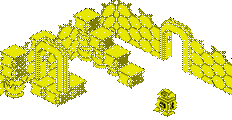


Jet Set Willy 2: The Final Frontier (1985) 


| Details (Sinclair ZX Spectrum) | Supported platforms | Artwork and Media | |
|---|---|---|---|
| Publisher: Genre: Author(s): Minimum Memory Required: Maximum Players: Joysticks: Language: Media Code: Media Type: Country of Release: Related Titles: Other Files: Comments: |  Software Projects Software ProjectsArcade Derrick P. Rowson 48K 1 - Eng N/A Audio cassette Europe Manic Miner , Code sheet | Click to choose platform: Amstrad CPC Commodore 64 Sinclair ZX Spectrum More from other publishers: Acorn BBC Acorn Electron |

| Videos | Screenshots (Sinclair ZX Spectrum) |
|---|---|
        |
Please login to submit a screenshot
| Your Reviews |
|---|
 Issue 41 (Sinclair User) 4th Jan 2010 12:17
IT IS EIGHT months late, and Matthew Smith had very little to do with it. Nevertheless, it's here, and Miner Willy rises from the grave in the final part of the Manic Miner trilogy.
If you can clear the clouds of nostalgia for a moment and look at the game objectively, it also seems to be the rip-off of the year. Jet Set Willy II is, in a nutshell, Jet Set Willy with about 70 extra screens.
The plot is the same - Maria the housekeeper won't let Willy go to bed until he's cleaned up the house. Unfortunately, builders have been to work. Rooms are not always where they were.
If you're puzzled by all this, Jet Set Willy was the ultimate ladders and levels game, launched in 1984 and one of the biggest selling games ever.
This expanded version continues in the same vein under the coding of D P Rowson, with rooms such as Maria in Space and Beam me up Spotty. Games attacked include Alien 8, and Tribble Trouble.
Jet Set Willy II is probably as tough as the original. The Banyan Tree is as vile as ever, as is the Wine Cellar. Graphics, which amazed us all at the time, now look dated, and the music does not improve with age. Movement is considerably faster, although the infinite death traps, where you cannot escape losing all your lives in quick succession, have multiplied.
If you already have Jet Set Willy, and have waited for the final game for a year, you'll probably be a little upset. If you never saw the original, then the sequel is the one to buy, and represents very fair value for a one time classic.
Publisher Software Projects Price £6.95
Memory 48K Joystick Kempston
***
Chris Bourne
If you can clear the clouds of nostalgia for a moment and look at the game objectively, it also seems to be the rip-off of the year. Jet Set Willy II is, in a nutshell, Jet Set Willy with about 70 extra screens.
The plot is the same - Maria the housekeeper won't let Willy go to bed until he's cleaned up the house. Unfortunately, builders have been to work. Rooms are not always where they were.
If you're puzzled by all this, Jet Set Willy was the ultimate ladders and levels game, launched in 1984 and one of the biggest selling games ever.
This expanded version continues in the same vein under the coding of D P Rowson, with rooms such as Maria in Space and Beam me up Spotty. Games attacked include Alien 8, and Tribble Trouble.
Jet Set Willy II is probably as tough as the original. The Banyan Tree is as vile as ever, as is the Wine Cellar. Graphics, which amazed us all at the time, now look dated, and the music does not improve with age. Movement is considerably faster, although the infinite death traps, where you cannot escape losing all your lives in quick succession, have multiplied.
If you already have Jet Set Willy, and have waited for the final game for a year, you'll probably be a little upset. If you never saw the original, then the sequel is the one to buy, and represents very fair value for a one time classic.
Publisher Software Projects Price £6.95
Memory 48K Joystick Kempston
***
Chris Bourne
Steve Wetherill () 20th Jun 2017 08:17Steve Wetherill, 25th October 2010
In response to Derrick’s correction above, Steve Wetherill sent the following on 25th October 2010:
With regard to Derrick’s comment on having access to source code, I can believe that it was never provided. Re-reading my comments, it might appear that I am saying that certain things (i.e., the stairs) required the original source code. That is not what I was saying — they were just hard to get perfect without the source.
In response to Derrick’s correction above, Steve Wetherill sent the following on 25th October 2010:
With regard to Derrick’s comment on having access to source code, I can believe that it was never provided. Re-reading my comments, it might appear that I am saying that certain things (i.e., the stairs) required the original source code. That is not what I was saying — they were just hard to get perfect without the source.
Derrick P. Rowson () 20th Jun 2017 08:14Derrick P. Rowson, 24th October 2010
On 24th October 2010 Derrick P. Rowson (the game's author) wrote to the author [of http://www.jdawiseman.com/papers/games/jsw2]...
Since you seem to to be in a better position than many people to appreciate this information, I will divulge answers that have perplexed you.
In the game JSW2 you ask the question:— why are some blocks missing in the Cartography Room?
… I checked the source code to see if the data was corrupt. IT IS NOT. The rooms are not listed. I checked the assembler part and verified that it was not a result of overflow, the rooms in question were allocated numbers that if doubled would overflow quite easily. The code that handles that part will not overflow. So I checked out the one part that you do not have any access to and that is my mind.
You are correct in assuming that the Secret passage is missing because of its inherent ambiguity about its position, another reason it is missing is because it’s meant to be secret. [Editor’s note: I should have thought of that.]
Without A Limb never counted as a real room, it contains no data and is only accessed by a death jump.
The lower rooms Well and Dinking Vater ? were missed out for the exact reason you mentioned. [Editor’s note: because they are below the bottom of the playable screen of the Cartography Room.]
But the above is NOT the reason WHY… The purpose of the Cartography Room is a means to edit the game as it was being written. From the point of game development there was no point in being able to go to these rooms and play them. They all had only one access point. And once the room had been accessed from another room, there was no need to access them again. In all other rooms there was a need to access and play from any point and the editor Cartography Room gave us that access.
It boils down to there being no reason to play them once the data for the room is written. Unlike all other rooms that need to be played from various starting positions. I coded in the blocks appearing routine as a puzzle to the end user.
I hope you find this information useful.
A subsequent email added a little more:
I am amazed at your speed of completion of this game. Steve and I played every room to check if they were possible to play. So we have played all the rooms and know that some can be a bit tricky. For example the Garden which is a simple room. It took me a long time to perfect the sequence of jumps needed to pass through it. To finish this game using the Cartography Room we used thousands of lives. And I personally thought no one would finish the game without some form of cheating.
Anyway best regards and a personal thank you for the information you have passed on to me. I now know more about some aspects of this game than I did when I wrote it.
An emulator, with saving of the state of the emulated machine, is indeed cheating. And finally:
The bulk of what Steve says is true … with this one exception:— We never had access to any source code from Mathew for any of his programs at any time, whether before, during or after the game was written.
On 24th October 2010 Derrick P. Rowson (the game's author) wrote to the author [of http://www.jdawiseman.com/papers/games/jsw2]...
Since you seem to to be in a better position than many people to appreciate this information, I will divulge answers that have perplexed you.
In the game JSW2 you ask the question:— why are some blocks missing in the Cartography Room?
… I checked the source code to see if the data was corrupt. IT IS NOT. The rooms are not listed. I checked the assembler part and verified that it was not a result of overflow, the rooms in question were allocated numbers that if doubled would overflow quite easily. The code that handles that part will not overflow. So I checked out the one part that you do not have any access to and that is my mind.
You are correct in assuming that the Secret passage is missing because of its inherent ambiguity about its position, another reason it is missing is because it’s meant to be secret. [Editor’s note: I should have thought of that.]
Without A Limb never counted as a real room, it contains no data and is only accessed by a death jump.
The lower rooms Well and Dinking Vater ? were missed out for the exact reason you mentioned. [Editor’s note: because they are below the bottom of the playable screen of the Cartography Room.]
But the above is NOT the reason WHY… The purpose of the Cartography Room is a means to edit the game as it was being written. From the point of game development there was no point in being able to go to these rooms and play them. They all had only one access point. And once the room had been accessed from another room, there was no need to access them again. In all other rooms there was a need to access and play from any point and the editor Cartography Room gave us that access.
It boils down to there being no reason to play them once the data for the room is written. Unlike all other rooms that need to be played from various starting positions. I coded in the blocks appearing routine as a puzzle to the end user.
I hope you find this information useful.
A subsequent email added a little more:
I am amazed at your speed of completion of this game. Steve and I played every room to check if they were possible to play. So we have played all the rooms and know that some can be a bit tricky. For example the Garden which is a simple room. It took me a long time to perfect the sequence of jumps needed to pass through it. To finish this game using the Cartography Room we used thousands of lives. And I personally thought no one would finish the game without some form of cheating.
Anyway best regards and a personal thank you for the information you have passed on to me. I now know more about some aspects of this game than I did when I wrote it.
An emulator, with saving of the state of the emulated machine, is indeed cheating. And finally:
The bulk of what Steve says is true … with this one exception:— We never had access to any source code from Mathew for any of his programs at any time, whether before, during or after the game was written.
Steve Wetherill () 20th Jun 2017 08:11Steve Wetherill, February 2006
Introduction
Steve Wetherill contacted the author of http://www.jdawiseman.com/papers/games/jsw2 in February 2006 with the following programmer's comments on Jet Set Willy II: The Final Frontier....
Hello — I came across your JSW2 game pages today, quite a nostalgia trip. The Jet Set Willy 2 game originated from the Amstrad CPC version of JSW, which I developed with Derrick Rowson while @ Software Projects all those years ago. JSW was the second game I coded professionally, having done the Manic Miner port to CPC again with Derrick previously. Derrick and I added all those additional screens (when compared to the original JSW) mainly because we were having a blast doing it. I left Software Projects to go and work at Odin Computer Graphics, and Derrick ported the Amstrad code back to the Spectrum after I left, whereupon it was released as JSW2.
Thanks for the trip down memory lane — certainly a blast from the past!
Steve Wetherill, who is contactable via stevewetherill.com, answered a question about the camel in ]:
It is a large version of a camel sprite that appears in some of the lower rooms. The camel, and various other enemies, were taken from the demo that I sent to Software Projects when I was applying for the job there the year before. Programmer art, indeed. So really, it was just a variation on Hero Worship, which is another large sprite.
and another question about why Willy can’t be played in the Oh $#!+!The Central Cavern!:
As I recall, the idea we had was that Willy was in some sort of recurring nightmare, which is why the Central Cavern is in there. I believe we considered making it playable, but there was some issue with the way the data worked that made it a bit tricky and then we were under a lot of pressure to finish the game. It was meant to be just a fun little bonus — I am not even certain that the powers that be @ Software Projects knew about the ending.
I will take a look at the map again and see what other notes I can share. One thing is that on the Amstrad, the Cartography room, as well as being a fun little screen in the game, was actually used by Derrick and I as a debug mode. We have a cheat code, that went: “EMMRAIDNAPRRRTT†(which is actually the initials to the words in a nursery rhyme), followed by either the ESC key or perhaps another key or two. [Editor’s note: the obvious question was asked: “Well, it was Derrick’s notion. But it is a kids counting rhyme, like: Eeny Meeny Macka Racka Air I Domi Nacka Alla Packa Rumpa Racka Rum Tum Tush. Or something like that. Quite possible that I got it wrong, it being nonsense (to me at least).â€] This enabled a cheat which would take you to the cartography room at any time upon the press of a key. Once there, instead of controlling Willy, you had a cursor and you could select which room to go to (all rooms were filled in). You would use the cursor keys (or joystick?) to select the room, which would take you to the room, and once there you again used the cursor to move Willy around the room to set his starting location. It is in the shipping game, and it was funny to see various hacks on the CPC that added primitive room select modes, when all the time a really cool one was already in the game! I am guessing that it is not in the Spectrum game, but who knows … :)
before sending lots of notes:
Here are some notes. Before I get into this, I want to make it clear that none of our additions for “JSW2†would have been possible without the original brilliant work by Matthew Smith, so nothing here is intended to detract from his efforts.
So here goes, some notes as per your map sections. Clearly, many of the screens were added to fill “gaps†in the original. I think we needed this so that the cartography room would make sense, so it may be that the gap filling was a later rather than earlier addition to the game, though other screens may have been added for different reasons. It was quite easy to physically make the new maps, since Derrick had written a cool map editor.
1. The Sewers.
This whole section is “inspired†by Holt Road. Holt Road was the street in Birkenhead where I lived while working for Software Projects. [Editor’s note: streetmap.co.uk; multimap.com; pictures of Matthew Smith et al in the terraced house in Holt Road.] I shared the place with Stuart Fotheringham (SP artist), and Marc Dawson (now Marc Wilding — SP C64 coder) [Editor’s note: believed to be contactable via Acclaim Studios Manchester] was a frequent guest. I think the reason these screens are so sewer-centric was due to an upsetting blocked drain incident that occurred when we were living there…
As you can see, Holt Road is one of the screens — those blocks on the lower right are two chairs and a sofa, in case it wasn’t obvious. The three screens to the right constitute the living room, a bedroom, and Downstairs. It doesn’t really make any sense, though the barrels in the living room may mean something to somebody. Holt Road was a rather steep hill, hence the Mega Hill. The downstairs has the water element probably due to aforementioned drain incident.
The sewer arches also bear some resemblance to the train station where I used to catch the train from Birkenhead to Liverpool (to the SP office) every day.
2. The West Map
The changes here were to do with the boat sailing to a desert island. There was some rumor that the original JSW game did something like that so we thought we’d add it.
I think the cheat screen was originally added to detect possible screen change cheat pokes, I don’t recall if we really used it though. The idea was if you cheated you could get to that screen, and so if you had been to that screen, then you obviously cheated. Something like that.
I am not sure if the Deserted Isle screen behaves the same as the Amstrad version; there, the middle tree collapses into the ground when the timer counts down AFAIK. (I really should fire up the game and play it I guess … this is all from memory). [Editor’s note: it is the same.]
3. Central Map
Trip Switch was for the boat and island sequence. Pretty standard room.
Willy's lookout is just a connecting room, note however that there are some birds in there. Those are more sprites from the demo I sent to Software Projects. Also, the birds represent Wonga; Wonga was the coding alter ego of Marc Wilding, and also the name of his budgie. So those birds represent Wonga the Budgie.
Wonga'S Spillage Tray is now obviously the bottom of Wonga’s bird cage, and so the stuff at the bottom is obviously, budgie spillage.
Continuing the theme, there is Willy's Bird Bath.
Seedy Hole is another reference to Holt Road (which is where Wonga, the budgie, resided), and so this was Wonga’s bird seed.
The Zoo is what some people called the programming offices @ Software Projects. There’s my camel sprite in there.
Decapitare was definitely Derrick’s idea. We have a few screens that use the counterbalanced “things on pulleysâ€.
Pit Gear On, In T' Rat Hole and Down T' Pit were references to Manic Miner, but also reflected the facts that i) I am from Yorkshire (so I was “OK†with the dialect aspect), and ii) I worked for a time for the “National Coal Boardâ€, and in fact did my “Basic Underground Training†at various “Pits†around Barnsley, S. Yorks.†[From an email of 10th June 2015: “Grimethorpe Colliery, where I did part of my underground training, was about 3,000ft deep at the shaft - one of the deepest in the UK I believe.â€] Rat Hole is what some of the miners would call the mines. I was tempted to write “Call T' Mines†there, oh boy.
We liked the idea of a deep well down there, hence the repeating Well screen. Derrick wanted to call the bottom one Dinking Vater ?.
Hero Worship and ] are variations on a theme. We figured that if there can be a giant elephant, there can be other loony screens just there.
Macaroni Ted was indeed a reference to Technician Ted. That game came out when we were finishing JSW CPC — it bore an uncanny resemblance to Manic Miner of course; it did have cool music though.
Dumb Waiter was just a pun on the waiter sprites and the lifts that are in there.
In the Belfry, we went ahead and placed a hunchback sprite. Seemed in-keeping.
The Rocket Room facilitates the journey to the USS Enterprise section.
4. Space Map
This is (hopefully) obviously the Starship Enterprise, kinda.
There are various screens in here that explore Star Trek themes. We took some of the high level things that occur on every Star Trek episode, lifts, phasers, teleports, the star drive etc and built rooms around them. And Tribbles. These rooms feature various sprites pulled from my SP demo plus a couple of new ones.
I’ve mentioned the extended role of the Cartography Room previously, on the CPC version.
Foot Room is an homage to the ending of Manic Miner, when you lose all your lives.
5. Teleport Zone.
Well, this section is a planet, such as might be seen on a Star Trek episode.
Loony Jet Set was a nod to Jet Pac.
Eggoids was a nod to Lunar Jet Man (one of my all-time favorite games, bloody difficult though).
Other comments
In the new screens contained in the Space Map and the Teleport Zones, we were really having fun pushing the combinations of block types in (hopefully) interesting ways, along with a few new ideas. I think Matthew Smith’s original screens were generally much more aesthetically pleasing (although I should note that the new screens were designed for the Amstrad and I am not sure the colors came across to the Spectrum version perfectly), however, neither Derrick nor myself are really artists, and art resources @ SP were scant, so we made the most of what we had. Really, this extra stuff was meant to be an interesting bonus, it was not meant to replace the original game, just to give players some new stuff to play with. At no time did we (coders) imagine this as a sequel in any way. We were just having fun with it, as countless others have done since (in terms of mods, etc). Effectively, were were the first JSW modders. :) Having said that, as I recall, we basically rewrote the game from scratch for the Amstrad (same with Manic Miner). We did have access to the original source code at a certain point, but I believe that we created Manic Miner CPC without the original source (in fact, Derrick had written a very nifty disassembler/hex editor and we used that to figure out the original game). When it came time to do JSW, I think initially we still did not have any source code, so we set out to disassemble that game too. I am pretty sure that this is correct, because it took forever to get the stairs (ramps) to work the same way as the Spectrum version. That sounds goofy now, since both Derrick and I were employed full time by Software Projects; I don’t really recall the specific reasoning. In any case, it was this new codebase that was ported back to the Spectrum for JSW2.
I think the colors are not as solid (attribute clash) on JSW2 vs JSW due to the different screen update systems. Matthew’s original code uses a full “off-screen†copy of both the screen pixel bits, and the attribute color bytes. Each frame is composed in these hidden buffers, and then once all updates are done, the screen is copied to the visible screen. In fact, there may be two copies of the screens sitting around in memory. When it came time to fit the expanded CPC game into memory on the smaller Spectrum, there would not have been room to do this (plus, the CPC codebase does not use that method either — it uses a raster-avoiding method). So, the result is that the attributes for moving objects can tend to fight with each other sometimes. It is only a minor detail of trivia, but worth noting.
Incidentally, in terms of any differences in spelling of room names between the original game/CPC version to the Speccy JSW2, that may be because the room names are compressed on the Spectrum JSW2 (and not on the CPC). This was presumably to save space (and fit into 48K); accordingly, there was probably a “re-typing†of names at some point, possibly leading to errors. [Editor’s note: explaining both Wonga'S Spillage Tray and We must peform a Quirkafleeg.]
Introduction
Steve Wetherill contacted the author of http://www.jdawiseman.com/papers/games/jsw2 in February 2006 with the following programmer's comments on Jet Set Willy II: The Final Frontier....
Hello — I came across your JSW2 game pages today, quite a nostalgia trip. The Jet Set Willy 2 game originated from the Amstrad CPC version of JSW, which I developed with Derrick Rowson while @ Software Projects all those years ago. JSW was the second game I coded professionally, having done the Manic Miner port to CPC again with Derrick previously. Derrick and I added all those additional screens (when compared to the original JSW) mainly because we were having a blast doing it. I left Software Projects to go and work at Odin Computer Graphics, and Derrick ported the Amstrad code back to the Spectrum after I left, whereupon it was released as JSW2.
Thanks for the trip down memory lane — certainly a blast from the past!
Steve Wetherill, who is contactable via stevewetherill.com, answered a question about the camel in ]:
It is a large version of a camel sprite that appears in some of the lower rooms. The camel, and various other enemies, were taken from the demo that I sent to Software Projects when I was applying for the job there the year before. Programmer art, indeed. So really, it was just a variation on Hero Worship, which is another large sprite.
and another question about why Willy can’t be played in the Oh $#!+!The Central Cavern!:
As I recall, the idea we had was that Willy was in some sort of recurring nightmare, which is why the Central Cavern is in there. I believe we considered making it playable, but there was some issue with the way the data worked that made it a bit tricky and then we were under a lot of pressure to finish the game. It was meant to be just a fun little bonus — I am not even certain that the powers that be @ Software Projects knew about the ending.
I will take a look at the map again and see what other notes I can share. One thing is that on the Amstrad, the Cartography room, as well as being a fun little screen in the game, was actually used by Derrick and I as a debug mode. We have a cheat code, that went: “EMMRAIDNAPRRRTT†(which is actually the initials to the words in a nursery rhyme), followed by either the ESC key or perhaps another key or two. [Editor’s note: the obvious question was asked: “Well, it was Derrick’s notion. But it is a kids counting rhyme, like: Eeny Meeny Macka Racka Air I Domi Nacka Alla Packa Rumpa Racka Rum Tum Tush. Or something like that. Quite possible that I got it wrong, it being nonsense (to me at least).â€] This enabled a cheat which would take you to the cartography room at any time upon the press of a key. Once there, instead of controlling Willy, you had a cursor and you could select which room to go to (all rooms were filled in). You would use the cursor keys (or joystick?) to select the room, which would take you to the room, and once there you again used the cursor to move Willy around the room to set his starting location. It is in the shipping game, and it was funny to see various hacks on the CPC that added primitive room select modes, when all the time a really cool one was already in the game! I am guessing that it is not in the Spectrum game, but who knows … :)
before sending lots of notes:
Here are some notes. Before I get into this, I want to make it clear that none of our additions for “JSW2†would have been possible without the original brilliant work by Matthew Smith, so nothing here is intended to detract from his efforts.
So here goes, some notes as per your map sections. Clearly, many of the screens were added to fill “gaps†in the original. I think we needed this so that the cartography room would make sense, so it may be that the gap filling was a later rather than earlier addition to the game, though other screens may have been added for different reasons. It was quite easy to physically make the new maps, since Derrick had written a cool map editor.
1. The Sewers.
This whole section is “inspired†by Holt Road. Holt Road was the street in Birkenhead where I lived while working for Software Projects. [Editor’s note: streetmap.co.uk; multimap.com; pictures of Matthew Smith et al in the terraced house in Holt Road.] I shared the place with Stuart Fotheringham (SP artist), and Marc Dawson (now Marc Wilding — SP C64 coder) [Editor’s note: believed to be contactable via Acclaim Studios Manchester] was a frequent guest. I think the reason these screens are so sewer-centric was due to an upsetting blocked drain incident that occurred when we were living there…
As you can see, Holt Road is one of the screens — those blocks on the lower right are two chairs and a sofa, in case it wasn’t obvious. The three screens to the right constitute the living room, a bedroom, and Downstairs. It doesn’t really make any sense, though the barrels in the living room may mean something to somebody. Holt Road was a rather steep hill, hence the Mega Hill. The downstairs has the water element probably due to aforementioned drain incident.
The sewer arches also bear some resemblance to the train station where I used to catch the train from Birkenhead to Liverpool (to the SP office) every day.
2. The West Map
The changes here were to do with the boat sailing to a desert island. There was some rumor that the original JSW game did something like that so we thought we’d add it.
I think the cheat screen was originally added to detect possible screen change cheat pokes, I don’t recall if we really used it though. The idea was if you cheated you could get to that screen, and so if you had been to that screen, then you obviously cheated. Something like that.
I am not sure if the Deserted Isle screen behaves the same as the Amstrad version; there, the middle tree collapses into the ground when the timer counts down AFAIK. (I really should fire up the game and play it I guess … this is all from memory). [Editor’s note: it is the same.]
3. Central Map
Trip Switch was for the boat and island sequence. Pretty standard room.
Willy's lookout is just a connecting room, note however that there are some birds in there. Those are more sprites from the demo I sent to Software Projects. Also, the birds represent Wonga; Wonga was the coding alter ego of Marc Wilding, and also the name of his budgie. So those birds represent Wonga the Budgie.
Wonga'S Spillage Tray is now obviously the bottom of Wonga’s bird cage, and so the stuff at the bottom is obviously, budgie spillage.
Continuing the theme, there is Willy's Bird Bath.
Seedy Hole is another reference to Holt Road (which is where Wonga, the budgie, resided), and so this was Wonga’s bird seed.
The Zoo is what some people called the programming offices @ Software Projects. There’s my camel sprite in there.
Decapitare was definitely Derrick’s idea. We have a few screens that use the counterbalanced “things on pulleysâ€.
Pit Gear On, In T' Rat Hole and Down T' Pit were references to Manic Miner, but also reflected the facts that i) I am from Yorkshire (so I was “OK†with the dialect aspect), and ii) I worked for a time for the “National Coal Boardâ€, and in fact did my “Basic Underground Training†at various “Pits†around Barnsley, S. Yorks.†[From an email of 10th June 2015: “Grimethorpe Colliery, where I did part of my underground training, was about 3,000ft deep at the shaft - one of the deepest in the UK I believe.â€] Rat Hole is what some of the miners would call the mines. I was tempted to write “Call T' Mines†there, oh boy.
We liked the idea of a deep well down there, hence the repeating Well screen. Derrick wanted to call the bottom one Dinking Vater ?.
Hero Worship and ] are variations on a theme. We figured that if there can be a giant elephant, there can be other loony screens just there.
Macaroni Ted was indeed a reference to Technician Ted. That game came out when we were finishing JSW CPC — it bore an uncanny resemblance to Manic Miner of course; it did have cool music though.
Dumb Waiter was just a pun on the waiter sprites and the lifts that are in there.
In the Belfry, we went ahead and placed a hunchback sprite. Seemed in-keeping.
The Rocket Room facilitates the journey to the USS Enterprise section.
4. Space Map
This is (hopefully) obviously the Starship Enterprise, kinda.
There are various screens in here that explore Star Trek themes. We took some of the high level things that occur on every Star Trek episode, lifts, phasers, teleports, the star drive etc and built rooms around them. And Tribbles. These rooms feature various sprites pulled from my SP demo plus a couple of new ones.
I’ve mentioned the extended role of the Cartography Room previously, on the CPC version.
Foot Room is an homage to the ending of Manic Miner, when you lose all your lives.
5. Teleport Zone.
Well, this section is a planet, such as might be seen on a Star Trek episode.
Loony Jet Set was a nod to Jet Pac.
Eggoids was a nod to Lunar Jet Man (one of my all-time favorite games, bloody difficult though).
Other comments
In the new screens contained in the Space Map and the Teleport Zones, we were really having fun pushing the combinations of block types in (hopefully) interesting ways, along with a few new ideas. I think Matthew Smith’s original screens were generally much more aesthetically pleasing (although I should note that the new screens were designed for the Amstrad and I am not sure the colors came across to the Spectrum version perfectly), however, neither Derrick nor myself are really artists, and art resources @ SP were scant, so we made the most of what we had. Really, this extra stuff was meant to be an interesting bonus, it was not meant to replace the original game, just to give players some new stuff to play with. At no time did we (coders) imagine this as a sequel in any way. We were just having fun with it, as countless others have done since (in terms of mods, etc). Effectively, were were the first JSW modders. :) Having said that, as I recall, we basically rewrote the game from scratch for the Amstrad (same with Manic Miner). We did have access to the original source code at a certain point, but I believe that we created Manic Miner CPC without the original source (in fact, Derrick had written a very nifty disassembler/hex editor and we used that to figure out the original game). When it came time to do JSW, I think initially we still did not have any source code, so we set out to disassemble that game too. I am pretty sure that this is correct, because it took forever to get the stairs (ramps) to work the same way as the Spectrum version. That sounds goofy now, since both Derrick and I were employed full time by Software Projects; I don’t really recall the specific reasoning. In any case, it was this new codebase that was ported back to the Spectrum for JSW2.
I think the colors are not as solid (attribute clash) on JSW2 vs JSW due to the different screen update systems. Matthew’s original code uses a full “off-screen†copy of both the screen pixel bits, and the attribute color bytes. Each frame is composed in these hidden buffers, and then once all updates are done, the screen is copied to the visible screen. In fact, there may be two copies of the screens sitting around in memory. When it came time to fit the expanded CPC game into memory on the smaller Spectrum, there would not have been room to do this (plus, the CPC codebase does not use that method either — it uses a raster-avoiding method). So, the result is that the attributes for moving objects can tend to fight with each other sometimes. It is only a minor detail of trivia, but worth noting.
Incidentally, in terms of any differences in spelling of room names between the original game/CPC version to the Speccy JSW2, that may be because the room names are compressed on the Spectrum JSW2 (and not on the CPC). This was presumably to save space (and fit into 48K); accordingly, there was probably a “re-typing†of names at some point, possibly leading to errors. [Editor’s note: explaining both Wonga'S Spillage Tray and We must peform a Quirkafleeg.]
Issue 19 (Crash) 14th Mar 2011 04:08There really isn't a great deal that can be said about this game that hasn't been said about its predecessor Jet Set Willy. Jet Set Willy II is a pretty faithful sequel.
The story begins soon after poor old Willy has had a nasty fall down the stairs. He should be in bed recovering but due to the mess left by some rather strange builders his wife Maria is having a fit and insisting that Willy tidies the house. On his journey round the mansion Willy is shocked to discover that it has a lot more rooms than he is paying rates for. The Builders are responsible, but why?
As before you must guide Willy around the house avoiding the myriad hazards razor blades and flapping loo seats to mention just two. As you pass from room to room you will notice objects be they bottles, glasses or even taps. These objects must be collected by guiding Willy over to them and touching them. This may mean having to dodge ' things' scampering up and down in your path, in which case you will have to apply a little skilful jumping. Some very nasty traps have been set for you, the conveyor belt is a cinch compared to some. Repeat the gathering process for each room of the house and hope that you make it to the end, whatever that may be.
CRITICISM
'I think that Jet Set Willy II is a brilliant game, but it's a shame so many of the screens are the same as Jet Set Willy. The graphics are identical- they still have the same degree of smoothness and clarity. I reluctantly have to conclude that I don't consider Jet Set Willy to be a sequel ... it's more of a Deluxe version. That said, the game is still up to a pretty high standard, better in some respects.'
'No doubt there are many people that have eagerly awaited the arrival of JSW2. It has been a long wait and my goodness, it wasn't worth one tiny minute! Admittedly there are thousands of people who bought JSW and no doubt there will be thousands who will buy SW2, but what you get for your £6.95 is an extra forty rooms to explore and work your way through. Great isn't it? The graphics are now somewhat dated and long past their prime. It's a shame that Software Projects didn't put their time and effort to better use and produce a totally new idea instead of extending an already dead and well-poked game. Definitely not my idea of a fun playing game, but I suppose it's quite a good buy if you haven't already got JSW1.'
'Here we go again on the final part (hopefully) of the Willy Trilogy. At the end of eighty-three we marvelled at the superb graphics and addictiveness of Manic Miner; in mid eighty-four we were astounded at the sheer size and playability of one of the first arcade adventures Jet Set Willy, which sparked off Poke Mania (or Candyitis as some people call it). Now a year on we can again be astounded by the playability and larger size of the same game that we were astounded by last year... I'm afraid to say that JSW 2 is not a great improvement on its parent. The main differences between JSW 2 and JSW are the extra screens and the speed -which is a touch faster, making the game slightly more playable. Another difference I have noticed is that it is easier to get into loops where you lose all your remaining lives. This is obviously very infuriating if you are well into the game. If you haven't seen JSW 1 yet (where have you been?!) I would recommend this game. I wouldn't tell players of JSW 1 not to buy this game either as it is interesting to play the extra screens. Generally I found this game playable, but I can see my interest deteriorating after a few weeks.'
COMMENTS
br />Control keys
Joystick: Kempston and Ram Turbo
Keyboard play: very good
Use of colour: very good
Graphics: as good as ever
Sound: nice tune
Skill levels: one
Lives: seven
Screens: over 100
General Rating: Very good... but not much progress.
Use of Computer 70%
Graphics 50%
Playability 60%
Getting Started 70%
Addictive Qualities 45%
Value for Money 72%
Overall 61%
The story begins soon after poor old Willy has had a nasty fall down the stairs. He should be in bed recovering but due to the mess left by some rather strange builders his wife Maria is having a fit and insisting that Willy tidies the house. On his journey round the mansion Willy is shocked to discover that it has a lot more rooms than he is paying rates for. The Builders are responsible, but why?
As before you must guide Willy around the house avoiding the myriad hazards razor blades and flapping loo seats to mention just two. As you pass from room to room you will notice objects be they bottles, glasses or even taps. These objects must be collected by guiding Willy over to them and touching them. This may mean having to dodge ' things' scampering up and down in your path, in which case you will have to apply a little skilful jumping. Some very nasty traps have been set for you, the conveyor belt is a cinch compared to some. Repeat the gathering process for each room of the house and hope that you make it to the end, whatever that may be.
CRITICISM
'I think that Jet Set Willy II is a brilliant game, but it's a shame so many of the screens are the same as Jet Set Willy. The graphics are identical- they still have the same degree of smoothness and clarity. I reluctantly have to conclude that I don't consider Jet Set Willy to be a sequel ... it's more of a Deluxe version. That said, the game is still up to a pretty high standard, better in some respects.'
'No doubt there are many people that have eagerly awaited the arrival of JSW2. It has been a long wait and my goodness, it wasn't worth one tiny minute! Admittedly there are thousands of people who bought JSW and no doubt there will be thousands who will buy SW2, but what you get for your £6.95 is an extra forty rooms to explore and work your way through. Great isn't it? The graphics are now somewhat dated and long past their prime. It's a shame that Software Projects didn't put their time and effort to better use and produce a totally new idea instead of extending an already dead and well-poked game. Definitely not my idea of a fun playing game, but I suppose it's quite a good buy if you haven't already got JSW1.'
'Here we go again on the final part (hopefully) of the Willy Trilogy. At the end of eighty-three we marvelled at the superb graphics and addictiveness of Manic Miner; in mid eighty-four we were astounded at the sheer size and playability of one of the first arcade adventures Jet Set Willy, which sparked off Poke Mania (or Candyitis as some people call it). Now a year on we can again be astounded by the playability and larger size of the same game that we were astounded by last year... I'm afraid to say that JSW 2 is not a great improvement on its parent. The main differences between JSW 2 and JSW are the extra screens and the speed -which is a touch faster, making the game slightly more playable. Another difference I have noticed is that it is easier to get into loops where you lose all your remaining lives. This is obviously very infuriating if you are well into the game. If you haven't seen JSW 1 yet (where have you been?!) I would recommend this game. I wouldn't tell players of JSW 1 not to buy this game either as it is interesting to play the extra screens. Generally I found this game playable, but I can see my interest deteriorating after a few weeks.'
COMMENTS
br />Control keys
Joystick: Kempston and Ram Turbo
Keyboard play: very good
Use of colour: very good
Graphics: as good as ever
Sound: nice tune
Skill levels: one
Lives: seven
Screens: over 100
General Rating: Very good... but not much progress.
Use of Computer 70%
Graphics 50%
Playability 60%
Getting Started 70%
Addictive Qualities 45%
Value for Money 72%
Overall 61%
(Anonymous) (Your Spectrum) 14th Dec 2008 09:13INFINITE POKES
Now, we've got a bit of a confession to make. Having hacked the game and come up with all the obvious POKEs we got a bit carried away. You'll see from the list that no normal person should ever want another POKE for JSWII again. But then again how many normal people have ever played JSW in the first place? Not us!
* Invincibility
This is pretty self-explanatory. With it you'll never be killed and you're free to walk wherever the whim takes you. The
only trouble is that if you walk off the Bow into the sea you just fall through it, out of the bottom of the screen and back to the top again. That's why you'll need the POKE for ...
* Walking on Killer Objects
Willy walks on water - and everything else that spells death. Combined with the Invincibility POKE, you can do some neat tricks like standing on the stars in the Cold Store. Good ol' twinkle toes, eh?
* Infinite Lives
The most obvious and most useful POKE of them all - so we could hardly leave it out.
* Random Number of Objects
If you reckon 150 objects is a bit over the top, then this is the POKE for you. As we've said, it's 149 too many for us!
* Select Start Room
You'll have to be careful when you're picking the room you want to start in, as poor old Willy can get walled up. And if you land on a nasty without the invincibility POKE it can get more than a little frustrating. [This Room List will come in handy as well.]
* Number of Monsters
You can use this to choose the maximum number of sprites you feel like facing in any room. This way you can give yourself a sporting chance in rooms like Eggoids and the Nightmare Room. Although you can pick a number from 1-15, there can never be more than 9. This is part of a binary AND instruction and not a simple COMPARE. This means that if you choose 3 and there are four sprites in the room, you won't get any. Of course, you can select zero but surely you want some sort of challenge. Ropes aren't affected by all this but you'll see that swing a lot faster when there's less to print on the screen. Tarzan-type tactics, I'm afraid.
* Fall Any Height
Although you can already do this if you're in vincible, it can often be more fun to play the game with just a couple of useful POKEs like Infinite Lives and this one.
* Trip Switch On
If you're really lazy you can use this POKE to save yourself the bother of even having to set the trip before you toddle off to the yacht.
* The Teleporter
Now you can really join the Jet Set - this is the age of the teleporter! As there wasn't one built in we've added it and made it a doddle to use. All you have to do is press T and that'll stop the game. Then type in the three digit number that corresponds to the room of your choice. But make sure you use three digits for the number - so, room 8 is 008. Any number larger than 134 will be ignored and any number bigger than 256 will have 256 subtracted from it until it isn't - if you see what we mean. Probably best to stick to the correct range and then you won't have to stretch the old maths.
So, what happens if you transport to a room and are found dead on arrival? Or rather you land on a sprite. Well, you're just returned to the room you started from where you can give it another go. Now we can't exactly claim any credit for this as it's a built-in feature of the game. And a right pain it is too sometimes if you're not teleporting. When you lose a life you're plonked back in a safe place but if that just happens to be a sprite start position, tough luck. It's a shame but because of the messy coding we couldn't do anything to remedy this.
* Screen Saver
To save a screen, select the teleporter with T and then press S. But remember to start your tape recorder before doing so. When it's finished, you can get the game going again by selecting room 000.
Has YS reader William Thompson found the final POKE for Miner Willy?
* POKEs A Plenty
The Quick Shot
This first listing is for all those of you who want infinite lives but can hardly wait to tear the cellophane off the game, let alone spend time typing. It's short and as well as all those lives it lets you choose your start room and the number of objects you need to finish. Alter the numbers in lines 20 and 30 to the ones you want and run it. 10 CLEAR 64999
20 LET obj=150
30 LET room=32
40 FOR n=65000 TO 65047: READ a: POKE n,a: NEXT n
50 PAPER 0: INK 0: BORDER 0: CLS
60 RANDOMIZE USR 65000
70 DATA 221, 33, 0, 64, 17, 56, 185, 62, 255, 55, 205, 86, 5, 243, 48, 240
80 DATA 33, 6, 254, 17, 197, 100, 1, 59, 0, 237, 176, 195, 0, 95
90 DATA 62, 255, 50, 67, 117
100 DATA 62, obj, 50, 126, 135
110 DATA 62, room, 50, 75, 117
120 DATA 195, 0, 112
All the POKEs and more ...
This program is hacker's paradise. It contains the teleporter and the save screen option as well as all the other documented POKEs - yes, even those in the smaller program. Even if you don't want all the POKEs, it's an idea to type them all in, save it, delete the ones you think are redundant when you run the program. That way you'll only have to do them once if you change your mind. Once again, lines 20 and 30 let you change the number of objects and the starting room and line 40 is for the maximum number of monsters per room. 10 CLEAR 64999
20 LET obj=150
30 LET room=32
40 LET mons=15
50 FOR n=65460 TO 65529: READ a: POKE n,a: NEXT n
52 DATA 205, 84, 31, 210, 152, 116, 62, 251, 219, 254, 203, 103, 194, 145, 117, 33, 3, 0, 229, 205, 142, 2, 205, 30, 3, 56, 248, 205, 142, 2, 205, 30, 3, 48, 248, 246, 32, 254, 115, 204
54 DATA 122, 115, 214, 48, 254, 10, 48, 227, 225, 6, 10, 132, 16, 253, 103, 45, 32, 216, 61, 254, 134, 210, 145, 117, 50, 130, 80, 195, 86, 117
60 FOR n=65000 TO 65044: READ a: POKE n,a: NEXT n
62 DATA 221, 33, 0, 64, 17, 56, 185, 62, 255, 55, 205, 86, 5, 243, 48, 240
64 DATA 33, 176, 244, 17, 176, 247, 1, 179, 143, 237, 184, 62, 247, 50, 164, 100
66 DATA 33, 76, 254, 17, 197, 100, 6, 1, 237, 176, 195, 0, 95
70 LET n=65100
72 READ a: IF a=999 THEN GO TO 1000
76 POKE n,a: LET n=n+1: GO TO 72
80 DATA 33, 221, 100, 17, 121, 115, 1, 51, 0, 237, 176, 33, 180, 255, 34, 140, 117, 62, 195, 50, 139, 117, 24, 51
82 DATA 0, 221, 229, 221, 33, 155, 115, 17, 17, 0, 175, 205, 198, 4, 27, 122, 179, 32, 251, 221, 33, 0, 64
84 DATA 22, 27, 61, 205, 198, 4, 221, 225, 62, 255, 201, 3, 22, 10, 10, 18, 1, 74, 83, 87, 32, 170, 0, 27, 0, 64, 0, 128
90 DATA 62, 201, 50, 248, 121: REM invincible
100 DATA 62, 255, 50, 67, 117: REM infinite lives
110 DATA 62, obj, 50, 126, 135: REM number of objects to collect
120 DATA 62, room, 50, 75, 117: REM start room
130 DATA 62, 255, 50, 115, 119: REM fall any height
140 DATA 62, mons, 50, 169, 123: REM maximum number of monsters
150 DATA 62, 0, 50, 222, 131: REM trip switch on
160 DATA 33, 254, 3, 34, 227, 118, 33, 220, 13, 34, 229, 118, 33, 123, 62, 34, 231, 118, 33, 4, 40, 34, 233, 118, 62, 8, 50, 235, 118: REM stand on death objects
999 DATA 195, 0, 112, 999
1000 PAPER 0: INK 0: BORDER 0: CLS
1010 RANDOMIZE USR 65000
Room Finder
Lost? Dazed by the maze of rooms? Let these two programs help. The first one saves off the data of all the room numbers and their exits. Type it in and then run it remembering to start your tape recorder to save the data before you press Enter as it won't wait for you. 10 INK 0: PAPER 0: BORDER 0: CLEAR 65439: FOR n=65440 TO 65511: READ a: POKE n,a: NEXT n
20 RANDOMIZE USR 65440
30 DATA 221, 33, 0, 64, 17, 56, 185, 62, 255, 55, 205, 86, 5, 243, 48, 240, 33, 185, 255, 34, 198, 100, 195, 0, 95
40 DATA 6, 134, 17, 0, 64, 33, 252, 186, 197, 35, 126, 35, 229, 102, 198, 12, 111, 48, 1, 36, 205, 77, 128, 43, 1, 5, 0, 237, 176
50 DATA 225, 193, 16, 231, 221, 33, 0, 64, 17, 246, 9, 175, 205, 198, 4, 195, 0, 112
This program will load and print the data to your printer. Of course, If you want the info to go to the screen, change LPRINT to PRINT in line 50. 10 CLEAR 39999: FOR n=50000 TO 50011: READ a: POKE n,a: NEXT n: RANDOMIZE USR 50000: LET l=40000
20 FOR n=1 TO 134: LET a$=""
30 LET a=PEEK l: LET l=l+1: IF a>127 THEN LET a=a-128: IF PEEK l>127 THEN LET a$=a$+CHR$ a: GO TO 50
40 LET a$=a
Now, we've got a bit of a confession to make. Having hacked the game and come up with all the obvious POKEs we got a bit carried away. You'll see from the list that no normal person should ever want another POKE for JSWII again. But then again how many normal people have ever played JSW in the first place? Not us!
* Invincibility
This is pretty self-explanatory. With it you'll never be killed and you're free to walk wherever the whim takes you. The
only trouble is that if you walk off the Bow into the sea you just fall through it, out of the bottom of the screen and back to the top again. That's why you'll need the POKE for ...
* Walking on Killer Objects
Willy walks on water - and everything else that spells death. Combined with the Invincibility POKE, you can do some neat tricks like standing on the stars in the Cold Store. Good ol' twinkle toes, eh?
* Infinite Lives
The most obvious and most useful POKE of them all - so we could hardly leave it out.
* Random Number of Objects
If you reckon 150 objects is a bit over the top, then this is the POKE for you. As we've said, it's 149 too many for us!
* Select Start Room
You'll have to be careful when you're picking the room you want to start in, as poor old Willy can get walled up. And if you land on a nasty without the invincibility POKE it can get more than a little frustrating. [This Room List will come in handy as well.]
* Number of Monsters
You can use this to choose the maximum number of sprites you feel like facing in any room. This way you can give yourself a sporting chance in rooms like Eggoids and the Nightmare Room. Although you can pick a number from 1-15, there can never be more than 9. This is part of a binary AND instruction and not a simple COMPARE. This means that if you choose 3 and there are four sprites in the room, you won't get any. Of course, you can select zero but surely you want some sort of challenge. Ropes aren't affected by all this but you'll see that swing a lot faster when there's less to print on the screen. Tarzan-type tactics, I'm afraid.
* Fall Any Height
Although you can already do this if you're in vincible, it can often be more fun to play the game with just a couple of useful POKEs like Infinite Lives and this one.
* Trip Switch On
If you're really lazy you can use this POKE to save yourself the bother of even having to set the trip before you toddle off to the yacht.
* The Teleporter
Now you can really join the Jet Set - this is the age of the teleporter! As there wasn't one built in we've added it and made it a doddle to use. All you have to do is press T and that'll stop the game. Then type in the three digit number that corresponds to the room of your choice. But make sure you use three digits for the number - so, room 8 is 008. Any number larger than 134 will be ignored and any number bigger than 256 will have 256 subtracted from it until it isn't - if you see what we mean. Probably best to stick to the correct range and then you won't have to stretch the old maths.
So, what happens if you transport to a room and are found dead on arrival? Or rather you land on a sprite. Well, you're just returned to the room you started from where you can give it another go. Now we can't exactly claim any credit for this as it's a built-in feature of the game. And a right pain it is too sometimes if you're not teleporting. When you lose a life you're plonked back in a safe place but if that just happens to be a sprite start position, tough luck. It's a shame but because of the messy coding we couldn't do anything to remedy this.
* Screen Saver
To save a screen, select the teleporter with T and then press S. But remember to start your tape recorder before doing so. When it's finished, you can get the game going again by selecting room 000.
Has YS reader William Thompson found the final POKE for Miner Willy?
* POKEs A Plenty
The Quick Shot
This first listing is for all those of you who want infinite lives but can hardly wait to tear the cellophane off the game, let alone spend time typing. It's short and as well as all those lives it lets you choose your start room and the number of objects you need to finish. Alter the numbers in lines 20 and 30 to the ones you want and run it. 10 CLEAR 64999
20 LET obj=150
30 LET room=32
40 FOR n=65000 TO 65047: READ a: POKE n,a: NEXT n
50 PAPER 0: INK 0: BORDER 0: CLS
60 RANDOMIZE USR 65000
70 DATA 221, 33, 0, 64, 17, 56, 185, 62, 255, 55, 205, 86, 5, 243, 48, 240
80 DATA 33, 6, 254, 17, 197, 100, 1, 59, 0, 237, 176, 195, 0, 95
90 DATA 62, 255, 50, 67, 117
100 DATA 62, obj, 50, 126, 135
110 DATA 62, room, 50, 75, 117
120 DATA 195, 0, 112
All the POKEs and more ...
This program is hacker's paradise. It contains the teleporter and the save screen option as well as all the other documented POKEs - yes, even those in the smaller program. Even if you don't want all the POKEs, it's an idea to type them all in, save it, delete the ones you think are redundant when you run the program. That way you'll only have to do them once if you change your mind. Once again, lines 20 and 30 let you change the number of objects and the starting room and line 40 is for the maximum number of monsters per room. 10 CLEAR 64999
20 LET obj=150
30 LET room=32
40 LET mons=15
50 FOR n=65460 TO 65529: READ a: POKE n,a: NEXT n
52 DATA 205, 84, 31, 210, 152, 116, 62, 251, 219, 254, 203, 103, 194, 145, 117, 33, 3, 0, 229, 205, 142, 2, 205, 30, 3, 56, 248, 205, 142, 2, 205, 30, 3, 48, 248, 246, 32, 254, 115, 204
54 DATA 122, 115, 214, 48, 254, 10, 48, 227, 225, 6, 10, 132, 16, 253, 103, 45, 32, 216, 61, 254, 134, 210, 145, 117, 50, 130, 80, 195, 86, 117
60 FOR n=65000 TO 65044: READ a: POKE n,a: NEXT n
62 DATA 221, 33, 0, 64, 17, 56, 185, 62, 255, 55, 205, 86, 5, 243, 48, 240
64 DATA 33, 176, 244, 17, 176, 247, 1, 179, 143, 237, 184, 62, 247, 50, 164, 100
66 DATA 33, 76, 254, 17, 197, 100, 6, 1, 237, 176, 195, 0, 95
70 LET n=65100
72 READ a: IF a=999 THEN GO TO 1000
76 POKE n,a: LET n=n+1: GO TO 72
80 DATA 33, 221, 100, 17, 121, 115, 1, 51, 0, 237, 176, 33, 180, 255, 34, 140, 117, 62, 195, 50, 139, 117, 24, 51
82 DATA 0, 221, 229, 221, 33, 155, 115, 17, 17, 0, 175, 205, 198, 4, 27, 122, 179, 32, 251, 221, 33, 0, 64
84 DATA 22, 27, 61, 205, 198, 4, 221, 225, 62, 255, 201, 3, 22, 10, 10, 18, 1, 74, 83, 87, 32, 170, 0, 27, 0, 64, 0, 128
90 DATA 62, 201, 50, 248, 121: REM invincible
100 DATA 62, 255, 50, 67, 117: REM infinite lives
110 DATA 62, obj, 50, 126, 135: REM number of objects to collect
120 DATA 62, room, 50, 75, 117: REM start room
130 DATA 62, 255, 50, 115, 119: REM fall any height
140 DATA 62, mons, 50, 169, 123: REM maximum number of monsters
150 DATA 62, 0, 50, 222, 131: REM trip switch on
160 DATA 33, 254, 3, 34, 227, 118, 33, 220, 13, 34, 229, 118, 33, 123, 62, 34, 231, 118, 33, 4, 40, 34, 233, 118, 62, 8, 50, 235, 118: REM stand on death objects
999 DATA 195, 0, 112, 999
1000 PAPER 0: INK 0: BORDER 0: CLS
1010 RANDOMIZE USR 65000
Room Finder
Lost? Dazed by the maze of rooms? Let these two programs help. The first one saves off the data of all the room numbers and their exits. Type it in and then run it remembering to start your tape recorder to save the data before you press Enter as it won't wait for you. 10 INK 0: PAPER 0: BORDER 0: CLEAR 65439: FOR n=65440 TO 65511: READ a: POKE n,a: NEXT n
20 RANDOMIZE USR 65440
30 DATA 221, 33, 0, 64, 17, 56, 185, 62, 255, 55, 205, 86, 5, 243, 48, 240, 33, 185, 255, 34, 198, 100, 195, 0, 95
40 DATA 6, 134, 17, 0, 64, 33, 252, 186, 197, 35, 126, 35, 229, 102, 198, 12, 111, 48, 1, 36, 205, 77, 128, 43, 1, 5, 0, 237, 176
50 DATA 225, 193, 16, 231, 221, 33, 0, 64, 17, 246, 9, 175, 205, 198, 4, 195, 0, 112
This program will load and print the data to your printer. Of course, If you want the info to go to the screen, change LPRINT to PRINT in line 50. 10 CLEAR 39999: FOR n=50000 TO 50011: READ a: POKE n,a: NEXT n: RANDOMIZE USR 50000: LET l=40000
20 FOR n=1 TO 134: LET a$=""
30 LET a=PEEK l: LET l=l+1: IF a>127 THEN LET a=a-128: IF PEEK l>127 THEN LET a$=a$+CHR$ a: GO TO 50
40 LET a$=a
(Anonymous) (Your Spectrum) 14th Dec 2008 09:12Yes, it's here! After all the waiting Software Projects has produced another Willy game - though it's not the now (perhaps) mythical Willy Meets The Taxman.
Jet Set Willy II started life on the Amstrad as a conversion from the original JSW. But the programmer added so many rooms that Software Projects heard the tinkle of the cash tills and thought it worth re-releasing on the Spectrum. And before you ask, this version was not written by Matthew Smith, who may or may not be working on something else - indeed, may or may not be working but by one Derrick Rowson.
This time round the game's been protected a might more than the original JSW and once again you have one of those funny colour charts to lose - but at least it's part of the insert this time! As all hackers know though, this only makes putting in the POKEs more fun.
So, how are the two games different? Well, all the original rooms are still there, although in some places new ones have been added to pad out the gaps in the original map. You can now get to the Conservatory Roof via the Banyan Tree and even complete it when you get there! The previously unique sprite from Under The Drive is also there now, plus plenty of other places. (Sounds as though someone's been cloning around! Ed). As for the rest of the re-decoration on the original rooms - well, the conveyor stairways in the Chapel and Halfway Up The East Wall are just ordinary stairways now and the music is the same as in Manic Miner. The reason for that becomes obvious when you finish the game.
It has to be said that some of the rooms aren't that thrilling - the first two you see after the Bathroom contain yet another dig at Eugene Evans (remember him? He wrote Wacky Waiters) and a reference to Technician Ted (the authors work for Marconi, geddit? Nope, well you'll just have to take a look!). From then on things start to look up - some of the rooms are really quite vicious and one, Dinking Vater? is impossible to escape from. There's also a room which you can't get to without cheating called, wait for it - Cheat.
Just take a look at the complete map of Willy's world to see how much it's grown. But that's enough about playing it. What I'm sure you're waiting for are the POKEs! All the data for the rooms is stored in a very different format to that used by Matthew Smith. Each room takes up a different amount of data depending on its contents. For that reason a room editor would be virtually impossible to write. Even the room names are compressed - every time the word 'the' crops up it's replaced with 01h and 'The Megatree' with 05h and so on. Each room's data address is found from a table at 47869 (BAFDh) so you can find the compressed room name followed by its four exits - and, of course, you can change them.
It looks as though the programmer has had a crack at trying to hide the lives counter - he uses a byte with the bottom bit set (11111110 in binary) and he rotates it when you die. So, when a zero falls in to the carry flag you've had your chips. It's tough luck on the programmer though, because when you've found this out, setting it to 255 11111111b gives you infinite lives with only one POKE. If only all programs were that easy to doctor! One side effect of this method, though, is that you can't turn off the golden oldie of a tune when you're playing the game. 'Ows about that then boys'n'girls. Aaaargh!
If you're dying to see how the game ends, you'll have to collect at least 150 of the 175 objects. This time round you'll not see our Willy exploring the depths of his loo because someone in the sickbay is doing that (Now that's sick! Ed) and the loo in the bathroom is fatal. Of course, if you reckon 150 objects is a bit steep, you can select the number of objects you want to collect. We find that one is a good number!
Jet Set Willy II started life on the Amstrad as a conversion from the original JSW. But the programmer added so many rooms that Software Projects heard the tinkle of the cash tills and thought it worth re-releasing on the Spectrum. And before you ask, this version was not written by Matthew Smith, who may or may not be working on something else - indeed, may or may not be working but by one Derrick Rowson.
This time round the game's been protected a might more than the original JSW and once again you have one of those funny colour charts to lose - but at least it's part of the insert this time! As all hackers know though, this only makes putting in the POKEs more fun.
So, how are the two games different? Well, all the original rooms are still there, although in some places new ones have been added to pad out the gaps in the original map. You can now get to the Conservatory Roof via the Banyan Tree and even complete it when you get there! The previously unique sprite from Under The Drive is also there now, plus plenty of other places. (Sounds as though someone's been cloning around! Ed). As for the rest of the re-decoration on the original rooms - well, the conveyor stairways in the Chapel and Halfway Up The East Wall are just ordinary stairways now and the music is the same as in Manic Miner. The reason for that becomes obvious when you finish the game.
It has to be said that some of the rooms aren't that thrilling - the first two you see after the Bathroom contain yet another dig at Eugene Evans (remember him? He wrote Wacky Waiters) and a reference to Technician Ted (the authors work for Marconi, geddit? Nope, well you'll just have to take a look!). From then on things start to look up - some of the rooms are really quite vicious and one, Dinking Vater? is impossible to escape from. There's also a room which you can't get to without cheating called, wait for it - Cheat.
Just take a look at the complete map of Willy's world to see how much it's grown. But that's enough about playing it. What I'm sure you're waiting for are the POKEs! All the data for the rooms is stored in a very different format to that used by Matthew Smith. Each room takes up a different amount of data depending on its contents. For that reason a room editor would be virtually impossible to write. Even the room names are compressed - every time the word 'the' crops up it's replaced with 01h and 'The Megatree' with 05h and so on. Each room's data address is found from a table at 47869 (BAFDh) so you can find the compressed room name followed by its four exits - and, of course, you can change them.
It looks as though the programmer has had a crack at trying to hide the lives counter - he uses a byte with the bottom bit set (11111110 in binary) and he rotates it when you die. So, when a zero falls in to the carry flag you've had your chips. It's tough luck on the programmer though, because when you've found this out, setting it to 255 11111111b gives you infinite lives with only one POKE. If only all programs were that easy to doctor! One side effect of this method, though, is that you can't turn off the golden oldie of a tune when you're playing the game. 'Ows about that then boys'n'girls. Aaaargh!
If you're dying to see how the game ends, you'll have to collect at least 150 of the 175 objects. This time round you'll not see our Willy exploring the depths of his loo because someone in the sickbay is doing that (Now that's sick! Ed) and the loo in the bathroom is fatal. Of course, if you reckon 150 objects is a bit steep, you can select the number of objects you want to collect. We find that one is a good number!
| Cheats | Trivia |
|---|---|
| There are no cheats on file for this title. | No trivia on file for this title. |
History
This title was first added on 9th January 2008
This title was most recently updated on 7th July 2017