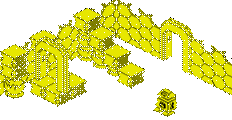
| Videos | Screenshots (Sinclair ZX Spectrum) | |
| |
Please
login to submit a screenshot
RetroBrothers (Unknown) 21st Sep 2010 03:45
Since we're in platform game mode (looking at Brian Bloodaxe last week), we may as well keep it that way as we look at one of the most famous platform games (perhaps any game) of all time.
Jet Set Willy (or JSW) was the follow up to the legendary Manic Miner (which we looked at back in May) and was released in May of 1984 by Software Projects. Once again programmer Matthew Smith stuck gold with Jet Set Willy which ended up being even more popular than Manic Miner.
In fact, this really is a true classic game that is known throughout the gaming community.
Our hero Miner Willy had become very rich due to his discoveries in the lost mines of Surbiton - his exploits as a 'manic miner' had paid off. Willy was now living the high life in a huge mansion which boasted more than sixty rooms (game screens - clever eh?) and had just thrown a huge party. The guests had left the place in a mess and Willy's housekeeper (the fearsome Martha) would not allow our poor tired hero get to his scratcher until the whole house had been tidied up.
And so begun Jet Set Willy....
Jet Set Willy managed to capture the magic of Manic Miner and added on more style, more locations and more fiendish puzzles to overcome. This arcade game featured the same wacky humour (such as rooms called 'we must perform a quirkafleeg' and the 'nightmare room' where Willy turned into a bat!)
The game also featured the usual strange range of nasties to avoid such as 'killer jellies' and rogue penguins - with each screen usually having it's own unique set of enemies adding more variety to the game.
Making the game a flick screen adventure was a good move by Smith too - a lot of the fun in the game could be had by 'going exploring' and trying to work out how to reach certain rooms. As usual your character could move left and right and could jump.
On at least one screen there was a swinging rope - a novel twist - which you had to 'jump' onto and use it to swing across the screen tarzan style. All of these touches made Jet Set Willy on the ZX Spectrum even better than the already classic Manic Miner.
This game also goes down as one of the first to feature 'anti-piracy' coding. Once the game had loaded you were presented with a screen asking for colour codes to be input - and the codes were stored within the cassette inlay card.
Jet Set Willy Anti Piracy ZX Spectrum Games
Jet Set Willy was a very addictive and innovative game when it was released and became one of the most talked about and POKED games in the history of 8-bit gaming. The game featured a yacht which was spread over two screens (Willy was VERY rich!) and rumours were spread about how you could activate a secret switch to make the yacht sail away to a tropical island! It was of course not true - but Matthew Smith would actually put this feature into the follow up Jet Set Willy II.
Unfortunately JSW was actually uncompleteable in it's original form. There were numerous bug throughout the game that made it impossible to collect all of the items - meaning you could not finish the game. The most famous of these was the 'Attic bug' - whenever you entered the room 'the attic' all other screens that you visited from that point onwards were corrupted. Software Projects quickly released POKES (the only way to 'patch' games back in those days) to fix all of the bugs in the program. Once the game was POKED it was possible to complete it.
ZX Spectrum Jet Set WillyPlenty of home users POKED the game themselves and a various editing tools became availabe allowing anyone to alter existing rooms and even to create new rooms and sprites. This made JSW last even longer for lots of gamers - an almost endless variety of rooms and nasties could be created this way.
On Release:
Jet Set Willy was the talk of classrooms, offices and homes up and down the land when it was released in 1984. Many had doubted that Matthew Smith could live up to his classic Manic Miner (a sequel to a true classic is never easy) - but despite the bugs in the game (people tended to 'not mind' these things back then if the game was good!) he did manage to surpass the first game in every way. The graphics were improved overall and sixty screens to explore was quite a feat back then. This and the imaginative rooms and nasties made JSW a top, top game. Crash Magazine smashed it, awarding JSW as whopping 95%.
The test of time:
Playing this game again brings back all of those memories - the room names come flooding back to you as you make your way around the mansion. It's never going to hold your attention for hours like it did twenty five years ago, but the old magic is still in there. JSW reminds me of a time when lots of locations in a game was totally impressive and a lot of the fun was simply finding new screens. Here in Spectrum Games we reckon (probably along with everyone else!) that Jet Set Willy is a true classic in the platform genre, and even a classic in the arcade genre.
We recommend getting hold of the real hardware but if not then download a ZX Spectrum emulator and download Jet Set Willy for the ZX Spectrum. Alternatively you could try and play it online.
If I was a rich man, dubba dubba dubba dubba dubba daahhh....
GENRE: Platform game (Arcade Game)
RELEASE DATE: May of 1984
RELEASED BY: Software Projects
DEVELOPER(S): The legendary Matthew Smith
PRICE: £5.95 - UK
Issue 4 (Crash) 14th Mar 2011 04:08
There were rumours that Matthew Smith was a figment of the Liverpool computing mass psyche, or merely a clever code name for a Tandy computer. There were rumours that Matthew Smith didn't really exist, and that if he did, then Jet Set Willy didn't and wouldn't. So, after all the waiting, was it worth it? In fact, it's probably worthless even reviewing Jet Set Willy, since by the time you read this you will probably have already worked out the boots to cheat the game!
The rags-to-riches story is already well known. Rich from his sub-Surbiton mining exploits, Willy has bought a huge mansion with over 60 rooms, most of which he has never seen. There's been a mammoth party and the guests have left the place in a dreadful mess. Willy just wants to go to bed, but his housekeeper, the nightmarish Martha, won't let him until every bit and piece has been picked up and tidied away.
It is always difficult to do a sequel to a best-seller. Not only should it have the same style, it should be bigger and better. Jet Set Willy seems to score on all counts. Very sensibly, it is actually a very different game to Manic Miner, much more of an adventure in which the player can move freely between the linking rooms and work out the structure of Willy's strange house. In keeping with a good adventure, there are some random elements that have been thrown in. In some rooms the hazards may change places, or disappear altogether. Some rooms may not be entered from a particular direction - you lose all your lives, and sometimes that does not happen. In all respects, the creation of all the rooms is exceptional, each with its own peculiarities. Some of them are very hard to solve.
Software Projects have included a complex colour code with the inlay, which must be looked after at all costs, since the game will not run without a correct code entry after loading is completed.
CRITICISM
'I consider this game not as a follow-up to Manic Miner, but as something quite different. It has a totally different game structure, more interesting graphics - like the swinging ropes that are highly realistic, bobbing rabbits, deadly razor blades, wobbling jellies and endless other inventions. Not a single graphic has been taken from Manic Miner, with the exception of Willy himself, now in a natty hat rather than his mining gear. Quite simply, the sound is excellent, the graphics are brill and the colour is great. A classic.'
'If Manic Miner was maddening, frustrating and fun then Jet Set Willy should certainly be put on the Government's list of proscribed drugs. The cynical manner in which you are given so many lives to play with is just typical of the extraordinary talent of Matthew Smith - mean through and through! I thought, well with so many lives it must be easy to get a long way. Yet they just disappear before your very eyes. The detail of the graphics is marvellous. The dreadful Maria with her pointing hand of accusation, the flickering candles, the grinning heads, the leaping security guards just everything has been worked as far as it can go. If there's no demo in this game, it is because it would spoil the fun of exploring the huge mansion, and besides, I doubt whether there's a nibble left in the memory, yet alone a spare byte before tea. Now I must get back to The Banyan Tree and try again for the tenth damned time in a row to get through...'
'Jet Set Willy is a high point in the development of the Spectrum game. I hope there will be others, maybe ones of a different kind, but I'm sure nothing will top this game for addictivity, fluent graphics, responsiveness and sheer imagination. The nightmare quality of the events suggests its author should be receiving therapy. Instead, he's probably getting rich. Good luck to him...'
COMMENTS
Control keys: alternate keys row Q to P left/right. SHIFT to SPACE for jump
Joystick: pointless having one, keyboard is much better
Keyboard play: highly responsive, but watch the tight spots, which have been purposely made as finicky as possible
Use of colour: excellent
Graphics: perfect
Sound: excellent
Skill levels: how nimble are your fingers?
Lives: 8
General Rating: to date, one of the most addictive and finest Spectrum games.
Use of Computer 90%
Graphics 96%
Playability 94%
Getting Started 90%
Addictive Qualities 98%
Value For Money 99%
Overall 95%
(Anonymous) (Your Spectrum) 14th Dec 2008 09:08
JSW - A HACKER'S GUIDE
If you always type MERGE "" whenever you load a game for the first time, then you can count yourself amongst that select programming group known as 'hackers'. Join Andrew Pennell on a journey through the machine code magic that comprises Jet Set Willy.
Although playing any game of the quality of Jet Set Willy is in itself great fun, the more mischievous among us get a double helping of kicks by peering into sections of the program - both to examine its structure and to alter certain attributes (in other words, to cheat).
The program itself can hardly be described as fully protected. Although the colour chart supplied will defeat most home pirates, the keener and more able ones will resort to any lengths to get bootlegs of the game. I know of one player who typed the whole chart into his word processor, and another who dutifully duplicated it all with felt tips. This latter soul gave me the biggest laugh - the fact is just a single POKE disables the entire coding mechanism!
The first thing I had to find was simply an 'infinite lives' POKE; eight lives are nowhere near sufficient. A delve into the code quickly unearthed the important DEC (HL), which was duly NOP'd out. This, however, is not the perfect solution. You'll probably have discovered that once the Attic has been visited, the program irrevocably alters itself - from there on in it's instant death if you enter four particular rooms. With infinite lives you're much more likely to find the Attic and, once you do, most of the rooms become blocked permanently. The (rather crude) solution I employ is simply to power down and re-load Willy from Microdrive cartridge, although cassette users could have a problem here.
Incidentally, my current version of JSW (on Microdrive, of course) has a menu on it complete with options to choose the number of lives, which screen to start on and the numbers of objects within the game. The code itself has also been modified so that by pressing a certain key, the screen contents can be saved on cassette as a SCREEN$ file and, using the routines described in my article Print Routines in this issue, dumped onto my Epson printer.
Anyway, - getting back to the Attic - I spent quite some time trying to find the piece of code that 'switched-in' this clever, if frustrating, effect; alas, to no avail. But the time wasn't wasted because during my investigations I turned up a number of other useful things including a way to find out the final solution. (By the way, if anyone out there has sorted out the POKE to disable the catastrophic 'Attic Attack' feature, please tell us here at YS.)
The first thing that amazed me about JSW was the fact that there's only about 4K of machine code in the whole program! There's some 22K of data for the rooms, sprites and sound, while the remaining 12K or so is all used as 'workspace' by the other routines. In fact, much of the code is concerned with scanning the keyboard and all the possible types of joystick (except the Interface 2 type), not just to move Willy!
As you may have discovered on the original Manic Miner, you could get to any screen after typing in a nine-digit number (or on the Software Project's version, a 10-digit word) while playing the game. On Jet Set Willy it's a little bit harder. Here you have to be in a particular room at a particular height when you type out the 10 letters. But the problem is, having done this, you enter a room not at a 'safe' place, but at your current position - so extreme care must be taken when changing rooms using this method. You'll find you can only access 39 rooms like this anyway (answers on a postcard please for how to access the other 21).
The first person to finish JSW received a prize of Champagne and glasses from Software Projects, but to prove your bona fides you had first to tell the company how many hidden objects there were and what happened when you then tried to go to bed. My first attempt at winning the splendid prize involved a couple of POKEs to remove the wall above Maria in the Master Bedroom (trying to get rid of Maria herself proved futile!). The POKEs worked and I could jump over her and into the bedroom proper. Touching the bed had no effect, while touching the pillow proved fatal - this was obviously not the way to cheat. A bit more time misspent listing out the code revealed both answers - and a single POKE allows anyone to see the final graphic effect, having picked up just one object! I 'm sure you'll be happy to know that I came nowhere near the first to come up with the final answer though - no champers for me ...
Anyway, I next built up a complete map of the house by sticking together screen dumps of each room - in a similar fashion to the illustration included with this article. However, I was still unable to see all of the objects. Finally, after much searching I stumbled upon a table that held the locations of each object - and found a few surprises. Some of them count as two, and others are 'invisible'; indeed, there's one somewhere on the First Landing which still eludes me.
Along with the program and all its data are some very weird bytes indeed. For instance, the data for a further screen which contains very little - and, in fact, it's possible to reach it without cheating - is called ']' and just appears to have been forgotten about. For reference, it lies above the Conservatory Roof. There are also some strange- looking instructions towards the end of the program that appear to address a very complicated piece of hardware; exactly what, I don't know.
Incredibly, the data for each screen is stored in only 256 bytes - 128 for the room's appearance, 32 for its title and the remaining bytes for sprite information.
There are also quite a few oddities in the program, such as when Willy turns into what appears to be a flying pig. In fact, using a few more POKEs, being the pig character all the time can be a distinct advantage on some of the screens (sorry, not in the Emergency Generator - eat your heart out Pink Floyd!).
There are also some strange sections in some of the rooms that are either impossible to get to, or are seemingly useless. In particular, I would question the need for the gap at the bottom right of Nomen Lumi and the useless exit on the right of the Emergency Generator. As well as all this, what is the subtle pun behind 'Dr Jones Will Never Believe This'? What is 'Nomen Lumi'? And what the devil is a 'Quirkafleeg'? - and is the act of performing one illegal below a certain age? The regular staff at YS and myself would also be glad of any reader's help solving the mystery of the Banyan Tree - it's obvious you've got to get on top of the right-hand side of it to approach the goodies in the Conservatory Roof, but none of us can get there without fiddling it - and apparently Matthew Smith has only done it once himself, so what chance have we mere mortals?
Jet Set Willy is a great game to play, and from a programmer's point of view the ideas are structured magnificently. Even with my custom version I've only managed to get hold of around 40 objects! My excuse is that I've spent most of my time fiddling around inside the listing, what's yours? Hack on, my friends!
Sue Denham (Your Spectrum) 14th Dec 2008 09:07
Every now and then, there comes a program that somehow prevents reviews from being written in a hurry - simply because tapping typewriter keys is cold comfort after you've negotiated the perilous journey up The Megatrunk, or collected the goodies from The Forgotten Abbey, or entered The Chapel and lived, or ...
Star of the Speccy screen, Matthew Smith, has finally delivered his follow-up to Manic Miner, and it's every bit as good and refreshing as the original. The story line is as weak as ever - some nonsense about Willy having thrown a party and the guests having left lots of champagne glasses strewn about his mansion (altered slightly in the production version). The aim is for him to collect all of these, because his housekeeper won't let him into the bedroom until he has. Weak it may be, still 'it's the game itself wot matters'.
The game is colourful, fast and ingenious. The controls are simple; you can move left or right and you can jump effortlessly into the air. And that's all there is to it - except, of course, that this is where all your problems begin!
CLOCK THIS
Press Enter and you're whisked from the title page to your first glimpse of Willy's 60-room mansion. That's you standing in the bath, staring at a flashing tap and a toilet (complete with moving seat (a la Manic Miner). The moral of the game is that virtually everything that isn't flashing will kill you should you be foolish enough to walk into it. You've guessed it ... the flashing objects are the ones you have to collect; there are 83 of them in all and the majority are very difficult to find indeed.
At the bottom of the screen, there's an indication of time. You begin your quest at seven in the morning (it must have been one heck of a party!) and the idea is to get into your bedroom by the hour of midnight. No, that doesn't mean you'll be sitting at the keyboard for 17 hours (although that wouldn't surprise me) for Matthew has thoughtfully shortened each minute to around 40 seconds. But anyway, this is unlikely to bother users for quite a time ... in the many weeks this game has taken to review, the clock has still never made it to eight in the morning!
When you begin playing you start with eight lives, which at first seems a bit excessive (ho ho) - until you venture past The Bathroom. It's worthwhile just having a wander around to get a feel for the way Miner Willy handles; for example, you can get Willy to hang precariously to a surface by what looks like a single pixel before making that important leap - and in some cases that's exactly what you'll have to do.
BATHTIME'S OVER
One step out of The Bathroom and you're thrust into the thick of Matthew Smith's fertile imagination - and what a place that must be! You can forget all
about malevolent space invaders and greedy Pac-persons, here the baddies are Swiss Army knives, razor blades, mini-chefs, grotesque faces, wobbling jellies, rolling eggs, ballet-dancing gerbils, a Monty Python foot, and ... need I go on?
That's not all you have to watch out for. The program has a nasty habit of thrusting you on-screen in a room you've just lost a life in - leaving you powerless to prevent all the remaining lives being eaten up in the same way. Try making some of the leaps across The Orangery, for instance. Should you miss your footing you're likely to end up falling down into The Swimming Pool and dying. The rest of your lives will then automatically be swallowed up in the same way, leaving you impotent with rage and uselessly hitting every key in sight, in a vain attempt to prevent the inevitable.
Another strange quirk is the way in which the rooms have been laid out. The top floor seems to have more rooms than the floor below, and the basement has even fewer. For instance, if you go from The Wine Cellar into the next room, you'll end up in The Forgotten Abbey - which according to my calculations is right over the other side of the mansion!
You can also reach some strange places by getting to the highest point of some rooms and jumping up. The first experience of this came after a timely leap from Rescue Esmerelda, which sent poor Willy headlong into the floor of Ballroom East. Also, if you try jumping off most of the other rooms on the top floor, Willy ends up in The Off Licence. Whether this just shows Matthew Smith's alcoholic sense of humour, I'll probably never know, but after a few hours of Jet Set Willy, it turns out not to be a bad suggestion at all.
Unlike Andrew Pennell (the little cheat!), the approach in the YS office was simply one of striking out with eight meagre lives, in an attempt to find all the rooms. Having located around 45 of them, we seemed to come across a bug: each time we walked into certain rooms, Willy lost all his lives. It was time for a frantic phone call to Software Projects' Alan Morton. "Ahah", said Alan, "you didn't by any chance visit The Attic did you?" Sure 'nuff, we had - and very proud we were at the time. "Well, that's just a little something we put in to make it a bit more difficult", came the heavily understated reply. (The feeling our end is that it's a bug being turned into an asset - but who knows, we could be wrong!)
Indeed, it does make the game "a bit more difficult" - in fact, nigh on impossible to be precise. Once you visit The Attic, the four guardians from The Chapel race off to guard the entrances to The Kitchen, West of Kitchen, Cuckoo's Nest and East Wall Base. So, for goodness sake remember to check these places out first (and all rooms beyond) before you set foot in The Attic - otherwise you'll only have to re-load the program from tape again and start over.
Another clever little trick you discover, even before getting to indulge in the delights of the game, is the way Matthew Smith has chosen to 'anti-pirate' his program. Using a colour chart (don't lose it or you'll be in a mess), you have to type in a code of four colours which you access from the chart via coordinates flashed on-screen. Obviously it's not fool-proof, but it should slow 'em down a bit.
Like Manic Miner, Jet Set Willy has a charm which sets it aside from virtually every other game on the market. On a personal level, I find Jet Set Willy to be infinitely superior to its predecessor - if only because a practised Jet Setter can travel throughout the entire gamut of rooms without dying; my failure to complete the 12th level of Manic Miner prevented me from ever having to face the traumas of the following levels.
Most of the objects cached in Jet Set Willy are attainable, but there are some which, even when working from carefully scaled maps of each room, seem impossible to retrieve without sacrificing a life. For instance, there's a tricky one to get on the third level of the Cold Store, a couple in the Wine Cellar, and the one in the Nightmare Room; this is made even more difficult by the sudden transformation of the Miner Willy character into an awkward flying pig shape. But if you really want to set yourself a task, try going after the goodies on the Conservatory Roof and see how well you make out.
If you enjoyed Manic Miner, then Willy is going to seem like the proverbial manna from heaven. Matthew Smith seems to have incorporated the best of his original creation, let none of his apparent fame spoil his wonderful sense of humour, and firmly set the blueprint for what I'm sure will be a very successful range of games - in much the same sort of way that Psion originally planned for Horace (remember him?).
In the meantime, it's good to see a program that'll rattle the software houses a bit and get them thinking along less traditional lines for their future releases. Full marks then to A&F Software for its Chuckie Egg which appeared in the wake of Manic Miner. Matthew Smith, meanwhile, is now happily ensconced in the Software Projects team (soon to be a director, we hear) - let's hope the association is both long and happy.
Okay, review over. Now, I think I'll just go and check out the Cuckoo's Nest - I almost managed to get the sparkler last time I tried ...
|
Add your own review for Jet Set Willy! Fill in this section now!
|
|
| Cheats | Trivia | | There are no cheats on file for this title. | The room called Nomen Luni is a take-off of Imagine's Zzoom game - in Latin, Nomen Lundi can be roughly translated as 'The name of the Game', Imagine's old catchline. But there's more to this than meets the eye. If you look at the central graphics blocks in this room, you wouldn't be blamed for thinking they gave the impression of the tail end of an aircraft. Now look at the room below (Under The Roof) - can you make out what could be the front end of the plane? Hey presto ... the joke is that a plane, probably from Imagine's Zzoom, has crashed into the top of of Willy's mansion. |
History
This title was first added on 30th November 2008
This title was most recently updated on 15th March 2014