


Graphic Adventure Creator (1986) 
| Details (Sinclair ZX Spectrum) | Supported platforms | Artwork and Media | |
|---|---|---|---|
| Publisher: Genre: Author(s): Minimum Memory Required: Maximum Players: Joysticks: Language: Media Code: Media Type: Country of Release: Comments: |  Incentive Software Ltd Incentive Software LtdAuthoring Brendan Kelly 48K 1 - Eng N/A Audio cassette Europe (£22.95) | Click to choose platform: Acorn BBC Amstrad CPC Commodore 64 Sinclair ZX Spectrum |
| Videos | Screenshots (Sinclair ZX Spectrum) |
|---|---|
| (no videos on file) |  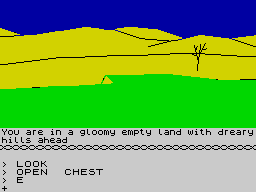 |
Please login to submit a screenshot
| Your Reviews |
|---|
 jdanddiet.blogspot (Unknown) 8th Apr 2012 05:33
In 1986, Incentive Software released The Graphic Adventure Creator. It was an instant hit thanks to its simple and easy to use interface, and gamers up and down the country immediately began compiling their own adventures. Incentive themselves began a dedicated label called Medallion to publish some of these efforts (ostensibly to demonstrate that the GAC could be used to create publication-standard adventures) and organised a competition via the Home Computer Club – a division of the Book Club Associates – to judge the best of the lot, with a £500 royalty advance the prize on offer from Incentive, as well as publication.
The competition was judged by Tony Bridge (PCW’s adventure columnist as well as an author himself) and it was only possible to enter if you bought your copy of the Graphic Adventure Creator via the Home Computer Club as this was the only edition that carried the required entry form. Up until this point, the main adventure-creating utility was The Quill, and this was the program used by 17-year old Darren Shacklady to create adventures for his college friends to play. As a member of the HCC, however, Darren decided to buy the GAC and give it a shot.
Getting going with GAC
“I could hardly wait for the GAC to arrive by mail,” says Darren, “and eagerly devoured the manual and example adventure provided when it finally did.” The bundled game was King’s Ransom, a beautiful, if somewhat shallow adventure.
“Despite the rather long loading time, my first impression of King’s Ransom was, well, short!” continues Darren, “and I found out afterwards that despite only half a dozen graphic screens and a dozen or so locations, the game is a full 32k, leading me to think the Spectrum would have trouble accommodating a full graphic adventure.” Darren’s solution to this almost came accidentally, but more on that shortly. How did his initial dabblings with The GAC go? “I tried to draw the interior of an inn,” he says, acknowledging the renowned rule that all fantasy adventures started in an inn or tavern of some description, “and the end result looked, frankly, shabby. My favourite adventure ever was the Hobbit, and in comparison I knew my efforts would not attract gamers for more than five minutes, good adventure or not.”
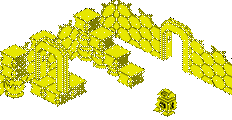
Darren turned his thoughts to his other favourite games at this point as he pondered on what sort of screen and graphics he’d like to see upon playing an adventure. Bo Jangeborg’s amazing Fairlight had been around a few months and it was a game that had won the budding adventurer’s heart thanks to its beautiful graphics and engaging plot. “So, I thought, what if I draw my inn in the Fairlight style, IE with isometric graphics? It only took a few minutes to bash out the nine basic lines you needed to present an isometric room with the details – furniture, a painting, the bar and a shaded wall – taking a little longer.” So was Darren satisfied with the results? “Yes, very much so. I suddenly had something that looked very much like a professional game, which for someone with very little skill in drawing made me realise this was definitely the way to go.” And there was a very favourable advantage to this method as well: “After designing much of the game and drawing several screens, it dawned on me that they took up hardly any memory!” This was down to partly the simplicity of Darren’s screens (nine lines, a shaded wall and a few objects) and the GAC itself thanks to its useful “merge screen” trick that enabled one basic design to be re-used.
King’s Ransom was an attractive adventure that demanded enough resources to make the adventure non-descript; Darren Shacklady had come up with a way of combining good graphics with plenty of gaming depth.
The competition was judged by Tony Bridge (PCW’s adventure columnist as well as an author himself) and it was only possible to enter if you bought your copy of the Graphic Adventure Creator via the Home Computer Club as this was the only edition that carried the required entry form. Up until this point, the main adventure-creating utility was The Quill, and this was the program used by 17-year old Darren Shacklady to create adventures for his college friends to play. As a member of the HCC, however, Darren decided to buy the GAC and give it a shot.
Getting going with GAC
“I could hardly wait for the GAC to arrive by mail,” says Darren, “and eagerly devoured the manual and example adventure provided when it finally did.” The bundled game was King’s Ransom, a beautiful, if somewhat shallow adventure.
“Despite the rather long loading time, my first impression of King’s Ransom was, well, short!” continues Darren, “and I found out afterwards that despite only half a dozen graphic screens and a dozen or so locations, the game is a full 32k, leading me to think the Spectrum would have trouble accommodating a full graphic adventure.” Darren’s solution to this almost came accidentally, but more on that shortly. How did his initial dabblings with The GAC go? “I tried to draw the interior of an inn,” he says, acknowledging the renowned rule that all fantasy adventures started in an inn or tavern of some description, “and the end result looked, frankly, shabby. My favourite adventure ever was the Hobbit, and in comparison I knew my efforts would not attract gamers for more than five minutes, good adventure or not.”
Darren turned his thoughts to his other favourite games at this point as he pondered on what sort of screen and graphics he’d like to see upon playing an adventure. Bo Jangeborg’s amazing Fairlight had been around a few months and it was a game that had won the budding adventurer’s heart thanks to its beautiful graphics and engaging plot. “So, I thought, what if I draw my inn in the Fairlight style, IE with isometric graphics? It only took a few minutes to bash out the nine basic lines you needed to present an isometric room with the details – furniture, a painting, the bar and a shaded wall – taking a little longer.” So was Darren satisfied with the results? “Yes, very much so. I suddenly had something that looked very much like a professional game, which for someone with very little skill in drawing made me realise this was definitely the way to go.” And there was a very favourable advantage to this method as well: “After designing much of the game and drawing several screens, it dawned on me that they took up hardly any memory!” This was down to partly the simplicity of Darren’s screens (nine lines, a shaded wall and a few objects) and the GAC itself thanks to its useful “merge screen” trick that enabled one basic design to be re-used.
King’s Ransom was an attractive adventure that demanded enough resources to make the adventure non-descript; Darren Shacklady had come up with a way of combining good graphics with plenty of gaming depth.
| Cheats | Trivia |
|---|---|
| There are no cheats on file for this title. | No trivia on file for this title. |
History
This title was first added on 21st July 2011
This title was most recently updated on 2nd February 2017