


Asterix and the Secret Mission (1993) 
| Details (Sega Game Gear) | Supported platforms | Artwork and Media | |
|---|---|---|---|
| Publisher: Genre: Author(s): Maximum Players: Joysticks: Language: Media Code: Media Type: Country of Release: Related Titles: Comments: |  SEGA SEGAPlatform / 2D Sega 1 (built-in D-pad) Eng - Cartridge Europe Asterix and the Great Rescue | Sega Game Gear |
| Videos | Screenshots (Sega Game Gear) |
|---|---|
| (no videos on file) |    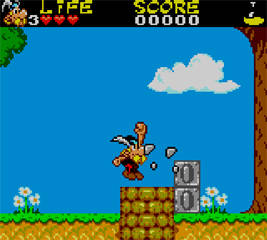  |
Please login to submit a screenshot
| Your Reviews |
|---|
 (Anonymous) (Unknown) 27th Mar 2012 05:37
"Gather 'round, conspiracy theorists..."
As far as game development goes, I don't imagine making unassuming licensed titles is particularly fulfilling work. Delivering the "product" in a quick and efficient manner matters more than the game itself, you tend not to get to do what you want to do because of licence and - more importantly - budget constraints anyway, and any extra effort beyond making the game moderately playable is likely to go unnoticed and unrewarded. There's no doubt that Sega's 1993 platformer Asterix and the Secret Mission was developed in such circumstances, and it shows. It's not all bad, though, and it could've been good, but it was deemed "good enough" a little too soon.
All departments were affected by this unfortunate decision, most notably the sound effects, but including, somewhat uncharacteristically, the graphics. Asterix and the Secret Mission features some of the most barren backgrounds and sparse sound effects I've ever witnessed in a game. I'm not complaining about the total lack of background animation and practically non-existent animation - I'm instead referring to entire stages where, with the exception of character sprites and the status bar, exactly three colours are used. Incidentally, three is also the number of sound effects - drown in 8-bit versions of Cacophonix's compositions - you'll be hearing in this game: there's the "jump" sound, the "punch" sound (but only if the attack connects), and the "item collected" sound. That's it - at least the shabby backgrounds are offset with some very detailed and tastily coloured backdrops in other levels, which leads me to believe that the artists were unable to finish their job while the sound designers just couldn't be bothered. Lastly, the character sprites are reasonably faithful reproductions of Albert Uderzo's creations but rather poorly animated, with the transitions between various actions particularly coarse-looking.
Unfortunately, The Secret Mission plays rather coarsely, as well. Asterix - but, inexplicably, not Obelix - is plagued by strange inertia, taking him at least a tenth of a second to start moving after the command has been input by the player. The controls themselves are not at fault here as they register instantly with Obelix, who, ironically, feels much nimbler and easier to play with as a consequence (but, in keeping with the irony, his special stages are even shorter - and easier - than Asterix's). Canned attack animations, however, are a problem with both characters. They cannot be combined with other moves, it's impossible to interrupt them and, most annoyingly, the characters aren't even in the attack mode until the first half has been fully executed. This means that Obelix in particular is prone to touching the enemy with his extending long arms in preparation for the attack, ending up getting hurt himself. Finally, inexplicable slowdown occasionally makes the game feel as if your character is wading through treacle instead of running - and on performance-enhancing potion at that! To be fair, the game never quite becomes unplayable on this account but it's certainly a testament to how unoptimised the game's engine is...
...and a likely explanation as to why there is not a whole lot happening on the screen at any one time. For an action game, the action itself is very thin on the ground: the enemies are few and far between, they only attack alone, and all of them except the bosses can be universally repelled with a single blow. The fact that there aren't any enemies with advanced patterns or special abilities was quite a let down, but I was even more disappointed to find the few enemies that change states do so only visually. For example, you come across Roman soldiers with round shields early on in the game. When you get close to them, they hide behind their shield and roll across the screen towards you. Any seasoned platforming fan would expect them to be invulnerable during the roll move, requiring the player to jump over them, but in fact, you can still safely punch them into next Tuesday. The boss fights, however, are reasonably original and genuinely challenging (thankfully, the boss fight is treated as a continue point) and thus probably the most enjoyable part of the game.
The Secret Mission, being a platforming game, contains relatively few platforms (except for the base one, obviously) - there sure are a lot of slopes, though. But seriously, apart from the occasional tricky jump and environmental hazards, the level design is generally perfunctory, haphazard and just plain boring. There are brief flashes of excellence to be found - mostly lifted straight out of various Castlevania titles - but the developers made sure that these were balanced against moments of utter idiocy, such as essential items being hidden beneath fake spikes (that just happen to look exactly like the regular ones) and situations you can't escape without taking a hit. Admittedly, there is constant item respawn and the number of continues is limited only by the battery life of your Game Gear, but I'd prefer if the gameplay issues had been properly sorted out instead.
I have no proof, but I'd bet money on my supposition that Asterix and the Secret Mission was rushed to the stores (to no particular effect) before it was actually finished. Think about it: the game makes no distinction between a life and a credit, keeps time for no apparent reason, keeps score that amounts to nothing, and gives the player unlimited continues. To me, these are remains of a functional game organisation, the kind you plan out before you start the actual programming, designing, and coding, and tie the loose ends with after you're done - there's nothing to it, really, if you let the game run its full development circle. And let's not forget that within its stages, The Secret Mission features numerous empty platforms with nothing to do, collect or even fall prey to there, occasionally takes place in front of positively empty backgrounds, and lets you dispose of all regular enemies with a single type of attack. Perhaps it's for this very reason that, at least for me, Asterix and the Secret Mission represents more than the sum of its parts. Normally, I'd put a game like that up for sale the moment I finish it, but with this one, I just can't bring myself to it.
Reviewer's Score: 4/10, Originally Posted: 01/05/07
| Cheats | Trivia |
|---|---|
| There are no cheats on file for this title. | No trivia on file for this title. |
History
This title was first added on 24th December 2006
This title was most recently updated on 27th March 2012