| Details (IBM PC) |
|
Supported platforms |
Artwork and Media |
Publisher:
Genre:
Author(s):
Minimum Spec:
Recommended Spec:
Minimum Memory Required:
Maximum Players:
Joysticks:
Language:
Media Code:
Media Type:
Country of Release:
Related Titles:
Comments:
|  Spectrum Holobyte Spectrum Holobyte
Flight Simulator
Gilman Louie, Les Watts
80286 CPU, 1 MB RAM, DOS 3.0, VGA, Innovation Sound Standard, Analogue joystick
512K
2
Yes
Eng
USA/Canada & Europe
Falcon
Falcon 3
| IBM PC
|
Please login to submit artwork |
| Videos | Screenshots (IBM PC) | |
| |
Please
login to submit a screenshot
 Trivia
 (Unknown) 8th Jun 2012 05:52
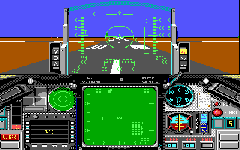
The graphics mode used was, similar to Sierra's Game Arts' game conversions, 640x200x16. This allowed simple dithering to create 64 pseudo-colors, and also represent the cockpit in higher detail.
(Anonymous) (Unknown) 24th May 2011 02:32
A vastly improved version of Spectrum Holobyte's widely popular game Falcon, with high-res EGA graphics, better mission planning, and a head to head mode.
(Anonymous) (Unknown) 24th May 2011 02:21
Falcon was originally designed and produced by Gilman Louie and programmed by Les Watts for the MSX (1984), under title of "F-16 Fighting Falcon") and Macintosh (1987 as "Falcon"), and used bitmapped 3D MiG-21s as adversaries. This was several years before Origin's Wing Commander used a similar graphics engine. It was ported to the PC later, but no longer used bitmapped graphics. Instead, the adversaries became primitive polygons instead.
In the original Falcon, users had their choice of flying one of 12 missions - with awards for flying missions at higher skill levels. The user had a choice of different ground attack and air-to-air weapons, although these were also limited by several factors. For dogfighting, AIM-9J missiles were not as reliable as newer AIM-9L missiles - and were useless for head-on attack - but were typically the only missiles available. Because they were guided, AGM-65 missiles were easier to use than "iron dumb bombs" like the Mk 84, but ineffective against strengthened targets. An ECM pod provides defense against enemy missiles, but occupies an external hardpoint that could be used for additional weapons or fuel. The enemy occupied the western areas of the game's playable map - itself a large square divided into 9 smaller squares. Enemy targets were fixed sites on the ground. For defense, the unnamed enemy was limited to MiG-21 interceptors, and ground launched missiles - either the SA-2, which was launched from identified and fixed sites on the ground, or SA-7 missiles which could be fired from portable launchers, and could therefore appear anywhere.
Falcon AT claims to be one of the first flight sims to use EGA graphics. In comparison to the older game, this version allowed external viewing of the player aircraft, and included the MiG-29 as an adversary.
TextFiles.com (Unknown) 10th Jun 2012 05:49
FALCON AT
When I first reviewed Spectrum HoloByte's FALCON, I closed with the hope that
EGA/VGA support would soon be available. FALCON AT fulfills this wish. Although
it derives a lot from its predecessor, FALCON AT is really a whole new game,
deserving of its own review.
As its name suggests, FALCON AT is designed for 80286/80386 class machines,
including PS/2s. EGA or VGA graphics are required, as well as 512K of RAM. The
program code uses 877K and comes on a 1.2 MB floppy. Two 720KB floppies are als
included for systems with 3-1/2" drives.
I tested FALCON AT on a GenTech 386-20, equipped with Everex EVGA graphics
card, Mitsubishi analog monitor, Gravis game card, and CH Mach IV joystick.
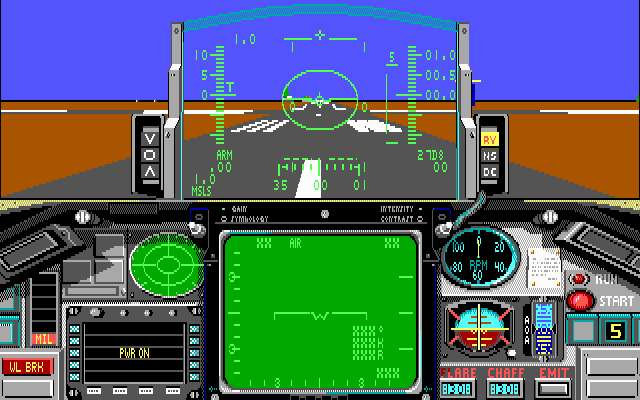
The sixteen-color EGA graphics of FALCON AT are detailed and impressive,
although only 640 x 200 resolution. Images are drawn by pixel, not line and
polygon fill. Explosions are especially nice. Inside the cockpit, HUD displays,
panel controls, and instruments look almost like a color photo. On the ground,
houses, barracks, bridges, towers, and other structures show surprising detail.
I flew close enough to a tank to see that its turret was rotating! The shadows
of the F-16 and nearby MiGs are visible when flying close to the ground.
All of the features and controls available in the original FALCON are included
in FALCON AT, plus some new ones. There are external views of the F-16 from a
friendly chase plane, the control tower, or an enemy MiG. The colors of the
ground, sky, and HUD can be changed to simulate weather conditions and
nighttime. The radar can show boresight and tracking views. Home base and
mission targets are assigned "waypoint numbers." Distance-measuring equipment on
the HUD displays miles from the selected waypoint, and the autopilot will fly
the plane to the waypoint (if there are no MiGs in the area). Afterburners have
five levels of power. There is a three-way CPU speed switch, which comes in
handy when playing the game on a 386 machine. There are visible and audible
ground proximity warnings that alert the pilot to imminent crashes.
Military ranks from First Lieutenant to Colonel denote levels of difficulty the
play of the game. Most of the missions are new; four missions are carried over
from original FALCON. New ground targets include tanks, parked aircraft, power
station, terrorist headquarters, and enemy barracks.
My first try at flying FALCON AT was humbling. I had recently completed all the
missions of the original FALCON in Major mode, and felt rather confident of my
piloting ability. I chose to take my first hop in FALCON AT as a Major, since
true aerodynamics are not simulated at Captain or Lieutenant modes. The FALCO AT
aircraft seemed very underpowered. Free of ordnance, the F-16 was unable to
maintain airspeed without afterburners. I pointed this out to Spectrum Holobyte
They were kind enough to send me versions 1.02 and 1.03(beta), which corrected
the power problem.
The biggest difference in playability between the two FALCONs results from the
change in size of the combat arena. Original FALCON's playing field is about 180
miles square. FALCON AT's is 42 miles square! The extra detail in ground scenery
and targets forced the programmers to shrink the area. I found myself on top of
my targets in about a minute with the CPU speed switch set to high. (The game
was more managable with the CPU speed switch set to low.)
My main complaint with FALCON AT is that the ILS does not function properly.
The indicator is supposed to guide you to a directional radio beam projected
from the runway. The FALCON AT ILS functions more like an ADF (automatic
direction finder). If the nose of the F-16 is pointed to the intersection of the
home base runways, the indicator shows no localizer deviation regardless of
heading. This gives you the false impression that you are actually lined up with
the runway. Every landing is a thrill, as the home airfield becomes visible at
mere four miles.
The graphic realism of FALCON AT overcomes its shortcomings. Dogfighting at the
higher levels of FALCON AT is more interesting than in the original FALCON. The
enemy MiG 21s and MiG 29s perform more in accordance with their specifications.
The ground targets are more realistically sized, and there is greater challenge
in hitting these smaller objects. For those who have been disappointed by th
graphics of other combat flight simulators, FALCON AT is the next best thing to
being there.
FALCON and FALCON AT are published and distributed by Spectrum HoloByte.
*****DOWNLOADED FROM P-80 SYSTEMS (304) 744-2253
�
|
Add your own review for Falcon AT! Fill in this section now!
|
|
| Cheats | Trivia | | There are no cheats on file for this title. | No trivia on file for this title. |
History
This title was first added on 11th November 2009
This title was most recently updated on 22nd January 2015