


Castles 2: Siege and Conquest CD32 (1994) 
| Details (Commodore Amiga) | Supported platforms | Artwork and Media | |
|---|---|---|---|
| Publisher: Genre: Author(s): Minimum Memory Required: Maximum Players: Joysticks: Language: Media Code: Media Type: Country of Release: Comments: |  Interplay InterplayStrategy 512K Yes Eng 3.5" Floppy disk Worldwide | Commodore Amiga |
| Videos | Screenshots (Commodore Amiga) |
|---|---|
| (no videos on file) |   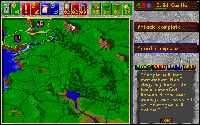  |
Please login to submit a screenshot
| Your Reviews |
|---|
 Feb 1994 (CU Amiga) 4th Dec 2011 03:43
This game is set in the fourteenth century, and you are a local lord who's out to become king of Bretagne. Several other lords also have their eye on the throne, and now the Church has intervened so you have to start crawling to the Pope if you want to get that kingship.
The route to the top involves grabbing as much land as possible, fighting the occasionally battle and keeping in with the church. The manual goes to great lengths to explain the politics between the various factions, but it doesn't really make any difference to the game.
The land is divided up into over a dozen territories, each of which has one of four natural resources, wood, gold, iron and food. You need all four of these to construct a castle and raise an army, so if you're missing any, you have to trade with your enemies or go without. Once you've got a few territories you can start buttering up the Pope by giving him any spare money or land you have.
Once you've consolidated your land and are sharing a border with your enemies, the game starts to slow down. Invading another territory is tricky because, even if you win a battle, your army is depleted leaving you open to invasion from other powers. The game has a few sub-plots but this doesn't alter the fact that nothing much happens and you don't need to do much to complete it. Just keep buttering up the Church who will eventually allow you to apply for the job as king, at which point all the other powers will attack you, to no avail, as you've spent the last half-hour building up you army. When it does come to a battle you can either let the computer sort out your tactics, which saves a lot of time and hassle, or coordinate the mayhem yourself, which invariably results in defeat. Castles 2 is a disappointment when compared to its playable predecessor.
63%
The route to the top involves grabbing as much land as possible, fighting the occasionally battle and keeping in with the church. The manual goes to great lengths to explain the politics between the various factions, but it doesn't really make any difference to the game.
The land is divided up into over a dozen territories, each of which has one of four natural resources, wood, gold, iron and food. You need all four of these to construct a castle and raise an army, so if you're missing any, you have to trade with your enemies or go without. Once you've got a few territories you can start buttering up the Pope by giving him any spare money or land you have.
Once you've consolidated your land and are sharing a border with your enemies, the game starts to slow down. Invading another territory is tricky because, even if you win a battle, your army is depleted leaving you open to invasion from other powers. The game has a few sub-plots but this doesn't alter the fact that nothing much happens and you don't need to do much to complete it. Just keep buttering up the Church who will eventually allow you to apply for the job as king, at which point all the other powers will attack you, to no avail, as you've spent the last half-hour building up you army. When it does come to a battle you can either let the computer sort out your tactics, which saves a lot of time and hassle, or coordinate the mayhem yourself, which invariably results in defeat. Castles 2 is a disappointment when compared to its playable predecessor.
63%
| Cheats | Trivia |
|---|---|
| There are no cheats on file for this title. | No trivia on file for this title. |
History
This title was first added on 1st July 2006
This title was most recently updated on 4th December 2011